Howard Rice Issues Press Release Featuring Attorney Blogs

In a bit of shameless self-promotion, I note that The Subprime Shakeout was featured, along with Steve Mayer’s blog, The California Constitution, in a press release issued by Howard Rice Nemerovski Canady Falk & Rabkin about the firm’s promotion of “thought-leadership” amongst its attorneys. Thank you to Howard Rice for its continued support of this endeavor to understand the subprime crisis and its ramifications.

Posted in Howard Rice, press, subprime | Leave a comment

Wikipedia Subprime Timeline a Comprehensive (and Opinionated) Resource

I just discovered the Wikipedia Subprime Crisis Impact Timeline that provides a great resource to those trying to understand what this crisis is and how we got here. The timeline spans 40 years from 1968 to the present, including the most recent entry as of this posting: “October 8 [, 2008]: White House considers taking ownership stakes in private banks as a part of the bailout bill. [108] Warren Buffett and George Soros criticized the original approach of the bailout bill.[109][110].”

Notably, the timeline pulls no punches regarding the many causes of this meltdown. It begins, appropriately, with the conversion of Fannie Mae from a government entity to a stand-alone GSE in 1968 (to purchase and securitize mortgages to facilitate liquidity in the primary mortgage market) and the creation of GSE Freddie Mac in 1970 (to buy mortgages on the secondary market, pool them, and sell them as mortgage-backed securities to investors on the open market). While I agree that Freddie and Fannie played no small role in fomenting the atmosphere that eventually led to this crisis, the choice to begin the timeline here seems to place the blame squarely at the feet of the GSEs.

But, the GSEs are not the only quasi-federal entities called out in this fascinating summary. In one of my favorite entries, Wikipedia cites an article from Barron’s Magazine for the following entry: “2003-2007: The Federal Reserve failed to use its supervisory and regulatory authority over banks, mortgage underwriters and other lenders, who abandoned loan standards (employment history, income, down payments, credit rating, assets, property loan-to-value ratio and debt-servicing ability), emphasizing instead lender’s ability to securitize and repackage subprime loans.[22]

Then, there’s this entry from October 15-17, 2007: “Both Fed chairman Ben Bernanke and Treasury Secretary Hank Paulson expressed alarm about the dangers posed by the bursting housing bubble; Paulson said ‘the housing decline is still unfolding and I view it as the most significant risk to our economy. … The longer housing prices remain stagnant or fall, the greater the penalty to our future economic growth.’[40]” This statement is remarkable in hindsight, as the Fed and Treasury failed to take any significant action to alleviate this crisis until September 2008, when they took over Freddie and Fannie and proposed the “Emergency Economic Stabilization Act.” Of course, this did not prevent Paulson from saying that the proposal was “an urgent matter, and we need to move quickly” as he called for the immediate passage of the largest government bailout since the Great Depression.

Check out Wikipedia’s subprime crisis timeline as this shakeout unfolds for some interesting perspective on the regulatory and legislative missteps that brought us to this point.

Posted in bailout, banks, Ben Bernanke, causes of the crisis, Fannie Mae, Federal Reserve, Freddie Mac, Hank Paulson, legislation, regulation, securitization, subprime, takeover, timeline, Treasury, Wikipedia | Leave a comment

BofA Settles Countrywide Suits with State Attorneys General for $8.68 billion. Deal Said to Provide Homeowners with More Relief than Federal Bailout

On October 6, California Attorney General Jerry Brown (pictured at left) announced that Bank of America, parent of Countrywide Financial Corp., had agreed to pay $8.68 billion to modify the home loans of over 400,000 homeowners in a negotiated settlement of the lawsuits filed by Attorneys General in 11 different states (previously discussed here, here and here). Brown hailed the agreement, thought to be the largest predatory lending settlement in U.S. history, as direct relief for homeowners damaged by Countrywide’s manipulative practices. “Countrywide’s lending practices turned the American dream into a nightmare for tens of thousands of families by putting them into loans they couldn’t understand and ultimately couldn’t afford,” Brown said (see LegalNewsline stories on the settlement and the reaction).

This settlement, which provides for the suspension of foreclosures for eligible borrowers with subprime and pay-option adjustable rate loans and a waiver of $135 million in various fees and penalties, certainly constitutes a step in the right direction towards bringing accountability to one of the lenders that fueled this crisis. Yet, Brown took this apparent victory for homeowners a step further by directly contrasting the deal with the recent Federal bailout. “Unlike last week’s congressional bailout, this loan modification program provides real relief for borrowers at risk of losing their homes,” Brown said. “Tragically, California and the other states have had to step in because federal authorities shamelessly failed to even minimally regulate mortgage lending.”

Though somewhat self-serving, Brown’s criticism of the government bailout is largely valid. Though the legislation pays lip service to homeowner relief, the bulk of the $700 billion authorized by Congress will be handed over to distressed banks in return for the mortgages and mortgage-backed securities they had a hand in creating. Few would argue that, indeed, the bailout bill has as its main purpose the stabilization of the financial markets and the prevention of further bank failures, rather than the support of homeowners struggling to make their mortgage payments (putting aside for the moment those who fraudulently obtained mortgages and have likely stopped making their payments months ago). Nor has this shortcoming been lost on those clamoring for voter support. Perhaps taking a page from Brown’s book, Barack Obama announced today that he would propose a 90-day moratorium on foreclosures for some homeowners as part of a plan to boost the economy and aid middle-income taxpayers. While again a positive step, what would this nation’s Founders have said if they knew the government they framed would end up stepping in to aid banks and financial markets before addressing the welfare of its citizens?

Posted in Attorneys General, bailout, banks, BofA, borrower fraud, Countrywide, Government bailout, homeowner relief, Jerry Brown, lawsuits, legislation, liquidity, predatory lending, stability | 4 Comments

Seventh Circuit Disallows Class Actions for TILA Violations

In August, I wrote about a major Seventh Circuit ruling on the way that could open the doors for borrowers to file class actions against mortgage lenders to rescind their loans. On September 24, the Seventh Circuit issued its ruling, slamming shut the courthouse doors on this class of plaintiffs.

As reported by the National Law Journal, the Seventh Circuit has issued its decision in Andrews v. Chevy Chase Bank, Case No. 07-1326, finding 2-1 that borrowers could not band together in class action suits to rescind their mortgages for Truth-in-Lending Act (TILA) violations. While some district courts have gone the other way, the 1st, 5th and 7th Circuits have now all held that TILA does not provide borrowers a class action avenue for recovery.

This ruling is a boon for many large lenders, most of whom likely eschewed large-scale predatory campaigns. However, it’s also a boon for those less scrupulous lenders who realize that borrowers will have a more difficult time funding predatory practice suits on their own dime.

The Court’s reasoning, that rescission suits are personal and individualized, may be accurate for the most part, but as the dissent argues, this intention is not at all clear from the language of TILA. Given the ambiguous langugage, it seems unnecessary to issue such a sweeping ban when individual judges could preclude the joining of disparate claims via the ordinary class certification process. In this manner, classes of borrowers who exhibit widely varying rescission arguments would be denied class cert, while borrowers citing similar predatory lending practices would not be precluded wholesale from pooling resources to go after an unscrupulous lender. There is certainly no shortage of those, these days.

Posted in Andrews v. Chevy Chase, appeals, banks, Chevy Chase, Complaints, lenders, litigation, predatory lending, rescission, Seventh Circuit, TILA | Leave a comment

Not-So-Free Market: Group of Large Hedge Funds Expected to Sue FSA Over Short-Selling Ban

Thanks to Bryan Carter and the Tuscan Group for passing along this article on the litigation expected to arise from the U.K. regulator’s decision to ban short-selling for financial company stocks.

On September 18, England’s Financial Services Authority (FSA) announced that it would impose a temporary ban on the short-selling of shares in all financial companies, a drastic maneuver that wreaked havoc on hedge funds and other investment groups that rely on the mechanism to balance, or “hedge,” their investments. The SEC, after claiming that it would not follow suit, enacted a similar ban the following day on hundreds of stocks, only some of them primarily financial companies.

Short-selling is ostensibly a bet that a company’s stock will decline, effectuated by borrowing the stock and selling it at the current price, and then repaying or “covering” the debt by buying back the stock at a later date (and presumably a lower price). Short-selling is not illegal, though it is illegal to spread false rumors to engender the decline in a stock price. Yet, the practice has been blamed for the recent downward spiral of many banking institutions (rather than their years of unchecked lending to people who could not afford mortgages, of course).

Short-selling is not used solely to bet against stocks, however, and is often used by funds for a variety of risk-management strategies. These funds were forced to immediately cover their positions upon the news of the ban. As expected, this, along with the Treasury and Fed’s contemporaneous announcement of a bailout plan, drove up the prices of many of these stocks, and regulators were able to extol the market’s glowing response to their plan.

But, what happened to the idea of a free market, where investors’ perceptions of the stock are allowed to determine its actual value? If investors are restricted from betting against stocks, this uptick in value is artificial and essentially illusory. This will undermine both confidence and liquidity (thereby increasing volatility) in the markets and many investors will move their money out of the U.S. and U.K. markets and into more predictable markets. It has already resulted in a “bloodbath” on Wall St. for many investors and funds who thought they knew the rules to the game, and protests came immediately from many market players.

The powerful backlash from this ban has already prompted the SEC to back off of its initially inflexible position and ease short-selling restrictions on “market makers,” while at the same time adding additional companies to the banned list that seem tenuously related (if at all) to banking (like IBM, see here). It will be interesting to see whether this backlash and resulting retreat will obviate the need for litigation, or whether funds will press ahead, both in the U.K. and the U.S., to recover their losses or object to the unprecedented restrictions that have suddenly been placed on their freedom of trade. We will monitor these developments closely.

Posted in FSA, hedge funds, investors, liquidity, litigation, SEC, short-selling, volatility | Leave a comment

Desperate to Stem Tide of the Credit Crisis, Fed and Treasury Propose What Could Be Largest Bailout in U.S. History. How Far Will the Fed Go?

In another desperate move to inject liquidity into the marketplace, the heads of the Fed and the Treasury began discussions with Congress late yesterday on legislation that would allow the Government to purchase hundreds of billions of dollars of depressed mortgage-backed securities. At the heart of this plan (dubbed the “troubled asset relief program” or TARP from a phrase used in a statement today by Treasure Secretary Henry Paulson) is the creation of a federally-backed investment vehicle into which banks could sell, at a massive discount, these toxic securities to the Government to remove them from their books. Though it is unclear how such securities would be valued, what is clear is that this would be the largest bailout by the U.S. Government since the Great Depression, and potentially the largest in its history.

Though, at the behest of the Fed and Treasury, Congress plans to work overtime over the next few days in the hopes of passing legislation to authorize this proposal, the Fed has not felt the need to obtain legal sanction for its slew of recent bailouts. These include subsidizing the sale of Bear Sterns to JPMorgan in March, bailing out Freddie and Fannie last week, and issuing a loan of $85 million to effectuate the takeover insurance conglomerate AIG this week and save the behemoth from insolvency. Questions abound over the legality of this last move, some of which are addressed here, though few jurists seem to believe that a court would even entertain a challenge to the Fed’s action.

Though litigation to challenge or block the Fed’s recent actions might not bear fruit, there is little doubt that the continued expansion of this crisis will bring a new wave of lawsuits to courts around the country. Just this week, for example, Merrill Lynch shareholders filed suit in New York State Supreme Court over BofA’s proposed buyout of the brokerage firm for $50 billion. The suit, filed by law firm Murray, Frank & Sailer, alleges that Merrill’s board has withheld from the public stockholders certain information regarding the financial condition of the brokerage and its prospects. In essence, the suit maintains that Merrill CEO John Thain and its board acted in their own best interests at the expense of their shareholders, who were denied fair process and terms in the sale.

Such suits have become and will continue to be commonplace as shareholders bear the brunt of the efforts of struggling financial institutions to avoid drowning in the abyss of the credit crisis. But will anyone step up and challenge the unprecedented actions of the Federal Reserve or the Treasury in seeking to stop the financial dominoes from falling? While it’s far from clear whether the Fed’s authority to give emergency loans allows it to step in and take over struggling financial institutions, only time will tell whether such a challenge would even make it through the jurisdictional gates of the courthouse.

Posted in acquisitions, AIG, bailout, Bear Stearns, BofA, class actions, Fannie Mae, Federal Reserve, Freddie Mac, Government bailout, JPMorgan, jurisdiction, Merrill Lynch, shareholder lawsuits, TARP, Treasury | Leave a comment

Fed Takeover of Freddie and Fannie May Provide Temporary Stability, But Is it Just a Band-Aid?

By now, most have heard the news that the Federal Government stepped in on Sunday to exercise the authority granted to it by Congress in July to bail out government sponsored enterprises (GSEs) Freddie Mac and Fannie Mae. The major features of the move include the ouster of the two companies’ chief executive officers, the acquisition by the Treasury of $1 billion of the companies’ preferred stock and a pledge of up to $200 billion more, and the placing of the companies in conservatorship (a type of federally-managed bankruptcy) with management control placed into the hands of the Federal Housing Finance Agency.

This report in the Silicon Valley Business Journal discusses the potential impact of the takeover on interest rates and taxpayer dollars. Government officials, such as those quoted in this fascinating MSN article, have hailed the move as providing necessary stability to a volatile market and keeping mortgages affordable. Others are questioning whether this will be enough to balance out the markets, especially given the cost (see Seattle Times article here).

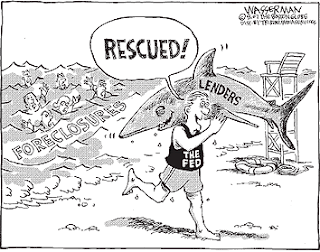
Though few can argue that the stability of the mortgage markets is a worthy goal, I find the takeover troubling for a variety of reasons. Fannie Mae was created as a government agency in the late 1930s expressly to provide liquidity to the mortgage market. It was later converted into a private corporation in 1970, at the same time that Freddie Mac was created to provide competition to Fannie’s monopoly, to establish a secondary market to purchase mortgages and repackage them as securities. Since then, these organizations have existed as quasi-governmental entities in the murky ether between public and private. This uncertainty about what exactly these organizations are and who they represent has often led to an increase rather than a decrease in volatility in the mortgage markets.

This has been especially true in recent months as speculation about Freddie and Fannie’s fate swirled around Wall Street. If these are governmental agencies, then they should be supported by the full faith and credit of the United States Government. If they are private corporations, then they should fail. Instead, we have seen them handled with hesitancy, and with a bailout that many say has come too late.

But the status of these organizations is really a secondary question to the one that nobody seems to want to address – is the stated purpose of Freddie and Fannie a goal the U.S. Government, or anyone for that matter, should promote? Namely, do we really want to artificially inject liquidity into the mortgage market? This entire subprime crisis, and the broader credit crisis it has spawned, can be fairly attributed to an excess of liquidity in the mortgage market. This and the process of securitization, by which each player in the chain (borrower to broker to lender to investment bank to investor) could pass on the risk of a mortgage to the next, created a market in which anyone who could fog a mirror could get a loan. Was this a good thing? Nobody cared if a given borrower could really repay a loan because the secondary market’s appetite for these loans was voracious. Did this ultimately result in either a stable or a liquid market?

This takeover is therefore all the more troubling because it seems only to prop up the misguided policy at the heart of this crisis. Returning to the stated goals of government officials, it’s clear that injecting liquidity into the mortgage market was again one of the foremost drivers behind this move. But, nobody stopped to ask whether keeping mortgages affordable for all who want them is a good thing. Maybe borrowers who cannot afford nice homes should settle for more modest homes or (gasp) rent until they can afford them. What a novel concept!

It seems to me that the goal should be a mortgage market that accurately reflects the value of real estate and the available financing, not one that treats home ownership as a Constitutional right.
Posted in broader credit crisis, causes of the crisis, education, Fannie Mae, Freddie Mac, legislation, lenders, liquidity, mortgage market, securitization, stability, subprime, takeover | 1 Comment

Borrowers Will Be Borrowers

Despite the increased attention directed at mortgage fraud since the collapse of the subprime market, fraud continues to be a major issue in newly-originated loans, reports the Mortgage Asset Research Institute (MARI). The study showed a 42% increase in in reported incidents of fraud in loans originated during the first quarter compared to a year ago.

This almost certainly has more to do with lenders beginning to actually investigate and report fraud on the part of borrowers (as opposed to encouraging it), than with an uptick in borrowers lying on their applications. Certainly, borrowers should bear a large degree of responsibility for the current subprime mess, as many lied about their income, employment, or intentions to secure loans they could not actually afford or profit by purchasing and then “flipping” or renting out properties they represented would be their homes.

But, this study illustrates that there will always be some borrowers who attempt to game the system for their own benefit. Only in an atmosphere of deregulation and encouragement by the lenders, markets and investors could these practices flourish and become the norm. This counsels in favor of stricter regulation of lending practices, criminal penalties for mortgage fraud, and more prescient investing by Wall St. and the ultimate investors to create the proper incentives for lenders to filter out fraud in its inception.

Indeed, MARI concluded in its Quarterly Fraud Report, “[a]s lenders pursue higher-quality loans for the market, the priority should be on identifying poor quality at the earliest possible point in the process — and at the lowest possible cost. In MARI’s view, the origination and prefunding processes offer the largest and least expensive opportunities to assure funding of higher-quality loans. How a lender accepts or rejects a loan application at the front door is often all a criminal needs to see how much further he or she may push through the loan process.”

Posted in borrower fraud, incentives, MARI, mortgage fraud, overstated income, regulation, subprime | Leave a comment

Indiana Piles On

Indiana Attorney General Steve Carter has brought a lawsuit against Countrywide Financial Corp., making it the latest of a half dozen states going after the nation’s former number one mortgage lender for improper lending practices (see Reuters article here). This suit focuses on Countrywide misleading borrowers about the rates and fees associated with their loans and encouraging its brokers to steer borrowers into riskier and ultimately more costly mortgages.

One begins to wonder when the mounting pressure on Countrywide from this flood of litigation will begin to spur Bank of America to take action. BofA has said publicly that it will not guarantee Countrywide’s debts (e.g. here and here). But news last month that BofA transferred Countrywide’s liabilities into a subsidiary, Red Oak, which was then renamed to Countrywide Financial Corp., fueled speculation that those liabilities would indeed be assumed. Analysts from independent researcher CreditSights, Inc., after reviewing a BofA regulatory filing that showed how it was handling Countrywide’s debts, stated that, “[o]ur view continues to be that B of A will ultimately honor the outstanding indebtedness from (old) Countrywide, based on our discussion with the company following this filing, as well as our prior analysis.” (see story here)

Regardless, there’s no denying that BofA’s acquisition increases its overall credit and litigation risk, and that what was hailed as a steal of a deal is beginning to look like a sucker’s bet.

Posted in acquisitions, Attorneys General, banks, BofA, Complaints, Countrywide, lenders, liabilities, litigation, predatory lending, subprime | Leave a comment

Countrywide Sued by New Mexico Pension and Investment Funds

The Chicago Times reports that Countrywide has been sued on behalf of New Mexico’s state Investment Council, the Educational Retirement Board and the Public Employees Retirement Association for both conning homeowners into mortgages they could not afford and duping investors about the value and safety of securities backed by these shaky mortgages. The allegations as to Countrywide’s lending practices should sound familiar – they are similar to those alleged in recent suits by California, Florida, Illinois, Connecticut and the City of San Diego (see prior posting here). But the allegations regarding Countrywide’s issuance of securities are relatively new. As additional allegations surface about what was going down at the country’s former number one lender, it will be interesting to see whether Bank of America steps forward to take some responsibility for the debts of its new acquisition or if, as is more likely, Countrywide sags under the mounting pressure of its liabilities and goes the way of New Century and IndyMac. Stay tuned…

Posted in acquisitions, Countrywide, IndyMac, lenders, litigation, New Century, predatory lending, securities | Leave a comment