Under Countrywide Stipulated Judgment, Investors Must Be Consulted

After reviewing the Complaint filed by hedge fund Greenwich Financial Services against Countrywide and BofA and listening to the comments made last week by Greenwich CEO William Frey and his attorney regarding the case, I decided to take a closer look at the Countrywide settlement with the attorneys general of several states to see how it treated the investors holding the Countrywide-originated loans at issue. Frey has alleged that Countrywide’s settlement does not adequately take investor interests into account, while actually imposing the costs of the loan modifications required by the settlement on investors.

Upon closer examination of Countrywide’s Stipulated Judgment and Injunction with California Attorney General Edmund Brown (posted below), I was surprised to find that Countrywide is instructed several times to consult with or consider investor interests in the loan modification process, albeit in fuzzy language that may be easy to skirt.

For example, pursuant to Section 6.2.1(a), Countrywide is required to make “an individualized evaluation of the Borrowers’ economic circumstances… to determine if alternatives to foreclosure are available, and consistent with the directions of the investors, if applicable.” (emphasis mine)

In Section 6.2.1(b), Countrywide is required to “maintain the current practice of offering Delinquent Borrowers who desire to remain in their homes and who can afford to make reasonable mortgage payments loan modification or other workout solutions, subject to applicable investor guidelines and approvals.” (emphasis mine)

Finally, in what will likely be one of the key provisions at issue in the Greenwich action, Countrywide represents in Section 6.3.7(e) that it currently has, or reasonably expects to obtain, “discretion to pursue the foreclosure avoidance measures outlined in Section 6 of this Stipulated Judgment and Injunction for a substantial majority of Qualifying Mortgages. If [Countrywide does] not have discretion to pursue these foreclosure avoidance measures, best efforts will be used to obtain appropriate investor authorization.”

These provisions immediately raise several questions regarding which investors must approve these modifications. Would a majority of interested investors being in favor of the modifications constitute investor approval or authorization? Or could one disgruntled investor like Greenwich Financial have the ability to block all modifications involving loans in which it invested?

Moreover, the fuzzy language surrounding these provisions leaves their enforceability up in the air. What constitute “applicable investor guidelines and approvals”? Must these be found in the language of the respective Pooling and Servicing Agreements (PSAs)? “Appropriate investor authorization” certainly sounds like it stems from such agreements. Moreover, the term “best efforts” is highly subjective and unlikely to permit one investor to block an $8.68 billion settlement. Ultimately, the outcome of the suit by Frey and Greenwich Financial will probably turn on whether this Stipulation accurately and appropriately incorporates the language in the PSAs regarding the requirements for investor approval.

Countrywide Judgment http://documents.scribd.com/ScribdViewer.swf?document_id=8757860&access_key=key-1e9711dm3qwyfgwd0ejg&page=1&version=1&viewMode=


Posted in Attorneys General, BofA, Countrywide, Greenwich Financial Services, hedge funds, investors, Jerry Brown, lawsuits, litigation, loan modifications, settlements, stipulated judgments, William Frey | Leave a comment

William Frey and David Grais Appear on Fox News to Defend Greenwich Suit Against Countrywide

Greenwich Financial Services CEO William Frey and his attorney, David Grais, of Grais & Ellsworth LLP appeared on Fox News on Tuesday to answer questions about their lawsuit against Countrywide (see other postings on this story). In the segment, linked below, Frey maintains that Countrywide’s settlement with the attorneys general of several states requires a large portion of the cost to be borne by investors, rather than by Countrywide itself. Interestingly, Grais argues that “we are all in favor of modifications,” but also asserts that, “this is Countrywide’s problem and Countrywide ought to bear the cost of helping the borrowers, who they never should have made these loans to in the first place.”

You can view the full segment here.

Posted in costs of the crisis, Countrywide, Fox News, Greenwich Financial Services, investors, lawsuits, loan modifications, predatory lending, settlements, television coverage of the crisis, William Frey | Leave a comment

Details of Greenwich v. Countrywide Emerge

An article published on Monday in Business Week (available here) sheds some additional light on the lawsuit filed by Hedge Fund Greenwich Financial Services against Countrywide challenging its agreement to conduct large-scale loan modifications (previously discussed here, here, and here).

Though his name is not mentioned in the complaint, the moving force behind the lawsuit is Greenwich Financial CEO, William Frey, a self-styled “advocate for investors’ contractual rights” (see a short bio on Frey here). The complaint seeks class action status on behalf of “all persons or entities that own or hold certificates in one or more of” over 100 Countrywide securitizations.
As the Business Week article points out, Frey has been vocal in his opposition to loan modifications since March of this year and maintains that he’s on a crusade to protect the rights of all investors who purchased Triple A-rated bonds, not just those who bought bonds backed by Countrywide mortgages. Frey argues that such modifications violate contract law and thus discourage future investment in the U.S. financial system. Frey has received pressure from Washington legislators, including in the form of a letter signed by, among others, Barney Frank (D-Mass.), Maxine Waters (D.-Calif.) and Luis v. Gutierrez (D.-Ill.), to back off of his position and allow the bailout bill to go through. You can view Frey’s letter in response here.
An interesting side note raised by the article is that Ocwen Loan Servicing, the largest subprime mortgage servicing company, could become the target of additional lawsuits challenging loan modifications if workouts are found to violate securitization contracts. Though the general counsel for Ocwen is quoted as saying that servicers are bound to pursue modifications that benefit all parties, this becomes difficult when, as is often the case, the various parties’ interests conflict.
As loan modification looks to be central to any plan to stabilize the mortgage market, the outcome of these legal battles will be pivotal to the question of who bears the cost of the subprime and broader financial crises. Look for these lawsuits to heat up and multiply over the coming months.
Posted in BofA, contract rights, costs of the crisis, Countrywide, Greenwich Financial Services, lawsuits, litigation, loan modifications, Ocwen, securitization, stability, subprime, William Frey, workouts | 3 Comments

Greenwich v. Countrywide Complaint Now Available

Here is the Complaint brought by Grais & Ellsworth on behalf of hedge fund Greenwich Financial Services against Countrywide Financial Corp., Countrywide Home Loans, Inc. and Countrywide Home Loans Servicing LP (all now part of Bank of America) in the Supreme Court of the State of New York, County of New York (discussed earlier today here). The Complaint alleges two causes of action for declaratory relief, the first seeking a declaration that Countrywide must repurchase any loan on which it agreed to reduce mortgage payments and the second seeking a declaration that Countrywide must purchase those loans at a price not less than 100% of the unpaid principal balance (UPB).

From a legal marketing perspective, it appears that Grais & Ellsworth’s efforts to drum up a challenge to the settlement between attorneys general in 11 states and Countrywide/BofA–by publishing a “white paper” and an open letter on the subject and holding a meeting for prospective plaintiffs (see prior posting here)–were successful.

Interestingly, the provisions of the relevant Pooling and Servicing Agreements (PSAs) appear, from the limited language quoted in the Complaint, to mandate in a fairly straightforward manner that either Countrywide Home Loans (the lender) OR Countrywide Home Loans Servicing (the loan servicer) repurchase the modified loan from the Trust Fund at 100% of the UPB. The fact that the language refers to the “Modified Mortgage Loan” raises the question of whether Countrywide would be required to pay the UPB prior to modification, or the UPB after modification (which could have been reduced considerably by the terms of the workout). Stay tuned…

Greenwich v. Countrywidehttp://documents.scribd.com/ScribdViewer.swf?document_id=8614287&access_key=key-bhq0wzcyazjc837oxyt&page=1&version=1&viewMode=

Posted in Attorneys General, BofA, Complaints, Countrywide, Greenwich Financial Services, lawsuits, lenders, litigation, loan modifications, repurchase, settlements, William Frey, workouts | Leave a comment

Hedge Fund Greenwich Financial Files Lawsuit Against Countrywide (BofA) Over Loan Modifications

As anticipated and previously discussed (see last week’s post), a hedge fund has indeed sued Countrywide Financial Corporation (now a part of Bank of America) over loan modifications Countrywide agreed to make under the terms of a settlement reached with 11 state attorneys general in October. The New York Times has reported that the fund, Greenwich Financial Services, has filed suit in state court in New York claiming that it stands to lose money from modifications to loans in 374 Countrywide mortgage trusts, and that the terms of the contracts governing these securitizations require Countrywide to repurchase at face value any mortgages it modifies.

I look forward to reviewing the loan modification language contained in the Pooling and Servicing Agreements or Prospectuses for these securitizations. In my experience, loan modifications are generally permitted by standard securitization contracts under certain conditions, and repurchases are only required when a lender breaches its representations and warranties (often regarding the underwriting or characteristics of individual loans). I’d be surprised if the language explicitly required repurchase for any loan modification. (See an interesting discussion of this issue here, courtesy of the informative Baseline Scenario.) Instead, investors may be more successful arguing that the loans subject to modification were defective and should be repurchased for breaching the lenders’ representations and warranties.

Check back this week as I will try to track down and post this Complaint on The Supbrime Shakeout. [Update: the Complaint is now available here – IMG]

Posted in Attorneys General, BofA, Complaints, Countrywide, Greenwich Financial Services, hedge funds, investors, lawsuits, loan modifications, repurchase, securitization, subprime, underwriting practices | Leave a comment

Investors Cry Foul at BofA Settlement of Countrywide Suits. Why the Resistance?

Not everyone is pleased with Bank of America’s record-setting $8.68 billion settlement of lawsuits against Countrywide by attorneys general across the country (see previous post here). Under the agreement, BofA, which acquired Countrywide in July of this year, agreed to modify up to 400,000 mortgages by refinancing loans, lowering interest rates and reducing principal amounts, in what the bank described as a win for investors, borrowers and the mortgage market as a whole.

However, the Charlotte Observer reports that New York Law Firm Grais & Ellsworth is trying to drum up interest from investors in challenging the settlement on the grounds that, pursuant to their agreements with Countrywide, investors should have been consulted prior to BofA agreeing to any loan modifications or workouts. In a “white paper” published on the Grais & Ellsworth website (available here), partner Bruce Boisture states that “Countrywide plans to pay not a cent of its own (or, rather, of its parent Bank of America)” toward the settlement. “Instead, it plans to impose the cost of its settlement on the trusts into which the to-be-modified loans were securitized, and thereby onto holders of certificates in those trusts. In our view, Countrywide’s plan will violate the agreements that govern these trusts.”

In reading about this potential lawsuit, I recalled a recent article that appeared in the Village Voice depicting Lehman Brothers’ loan origination and servicing subsidiary, Aurora Loan Services, as the sleazy streetwalker of Wall St. (see picture above right). The article highlighted a number of instances in which Aurora took a hard line and attempted to foist foreclosure upon borrowers who missed payments but were still ready and able to pay.

At the time, I assumed that Aurora’s actions were driven by investor pressure, since Aurora no longer owned most of these loans, but merely serviced them on behalf of large securitizations. But why in the world would investors object to workouts or modifications that enabled borrowers to remain in their homes and continue making payments on the loans? It seemed to me that the costs associated with foreclosure, combined with the soft housing market, would likely impose a greater overall loss on investors than a workout structured so that borrowers continued to make reasonable payments into the securitization. Were investors simply hoping servicers would liquidate these mortgages in a short-sighted attempt to recover whatever money they could on their greatly depressed investments?

A Wall Street Journal report last week on the potential challenge to the BofA settlement helped to shed some light on this question. The Journal notes that several investors it interviewed indicated that loan modifications, if done properly, could benefit investors. However, it points out that some investors believe that many of the loans at issue violated the representations and warranties made by the lender when the loans were packaged into securities. As a result, these investors believed these loans should be repurchased by BofA rather than modified.

Ah, now things are becoming a little clearer. So, investors are not hoping for foreclosure, as most realize this would be the costliest route. Instead, they are hoping that BofA and other lenders will foot the bill for repurchasing entire mortgages due to breaches of reps and warranties. In our representation of a mortgage insurer, we have seen that such breaches, including defects like improper underwriting, fraud or negligence in the origination process, non-qualifying loan characteristics, and early payment defaults, are often rampant in pools of recent vintage sub-prime and Alt-A loans. The question is, are investors more likely to recoup their investments by suing the lenders to force repurchase (many of whom are now bankrupt or under FDIC conservatorship), or by working with servicers to keep borrowers in homes? The best answer is probably a combination of both.

(Thanks to the Village Voice for the entertaining picture featured herein.)

Posted in Alt-A, Attorneys General, Aurora Loan Servicing, banks, BofA, Countrywide, investors, lawsuits, Lehman Brothers, lenders, repurchase, underwriting practices | 1 Comment

AMBAC Sues Bear Stearns Subsidiary For Shoddy Underwriting

Mortgage insurance company Ambac Assurance Corp. has become the latest plaintiff to bring a lawsuit against a mortgage originator for improper underwriting, suing Bear Stearns subsidiary EMC Mortgage Corp. in the United States District Court for the Southern District of New York. The lawsuit (available here) alleges that mortgage originator and “aggregatorEMC, under the control and behest of Bear Stearns, made loans that it knew borrowers could not afford to repay and sponsored securitizations that created a market for such defective loans. It further alleges that EMC made specific representations to Ambac to induce it to provide insurance for four separate securitizations, maintaining that the loans were underwritten without fraud, errors or omissions and that EMC would repurchase any loans that were found to be defective. Interestingly, while Ambac brings several claims based on EMC’s eventual breach of these representations and warranties, it does not bring a claim for fraud or negligent misrepresentation.

This lawsuit is structured very similarly to others that have been brought against mortgage originators, including the one we brought on behalf of PMI Mortgage Insurance Co. against WMC Mortgage Corp. and GE Money Bank in Los Angeles County Court. It details the many representations made by the originator in selling or acquiring insurance on the loans, notes the now-staggering delinquency rate of the loans, and then through due diligence reviews on random samples of loans, shows that the originator’s representations of quality underwriting could not have been true.

But, what’s most interesting about this action is the lengths to which Ambac goes to create a distinction between the poor performance of the loans stemming from the downturn in the housing market and the overall financial crisis, and the poor performance engendered by EMC’s irresponsible lending. For example, in paragraph 25, Ambac alleges that “EMC assumed the risk that the loans did not conform to its representations and warranties, while the insurers agreed to assume the risk that loan pools conforming to EMC’s representations did not perform as anticipated.” (emphasis in original) Ambac explains this concept further in paragraph 58:

The ability to evaluate the risk of the Transactions and adequacy of structural protections therefore depended on the ability to assess and control for the risk of default on the securitized loans. Certain default risk – e.g., due to changes in interest rates, changes in borrowers’ creditworthiness over time, adverse macroeconomic developments, and geographic concentration – is not subject to the control of the originator or sponsor, is measurable and quantifiable to an acceptable degree, and is the type of risk that Ambac knowingly assumes when it insures these types of transactions in exchange for a premium. Other default risk – e.g., due to misrepresented loan attributes, fraud or abject failures in origination and underwriting practices – depends directly on the controls, protocols, and practices of the originators and sponsor, and is not reasonably measurable or quantifiable by their counterparties.

While I admire these attempts to explain the complex subject of mortgage insurance in a straightforward manner, it seems this argument anticipates the defense that the downturn in the market is entirely responsible for these failing loans. And in this sense, methinks Ambac doth protest too much. Trying to explain what risks are anticipated and accepted by an insurance company to a judge or jury that likely has little experience with the subject matter might take the focus off of the main point – that the insurer and originator explicitly agreed that the insurer would not provide coverage for loans that were improperly underwritten. By sticking to detailing the representations and warranties made by EMC and the due diligence reports showing considerable breaches of these reps, the action would appear much more like an ordinary (and understandable) breach of contract case to an uninitiated audience.

Posted in Ambac, Bear Stearns, broader credit crisis, Complaints, lawsuits, litigation, misrespresentation, mortgage fraud, mortgage insurers, securitization, underwriting practices | Leave a comment

Focus of New Regulation Should Be On Securitization

The election of Barack Obama as the presumptive 44th President of the United States promises to usher in an era of increased regulation of the financial markets pursuant to Obama’s platform of economic reform. So far, many commentaries on the financial crisis, including this blog, have focused on the fact that subprime and Alt-A loans were made in an economically irresponsible manner, resulting in a default rate much higher than anticipated. This would suggest that financial regulation aimed at preventing this problem from reoccurring should focus on curbing lending to those who are unlikely to be able to repay their loans.

While this may be a good idea in general, new evidence has emerged that the extent of the financial crisis is not adequately explained by a higher-than-expected default rate among subprime and Alt-A loans. This article from the Economic Times reports that while losses in the financial system from all loans (accounting for the potential snowball effect that defaults have on home prices) have amounted to $425 billion, the financial system has suffered additional losses of $945 billion on investment in securities.

The article further explains that the reason why this second category of losses has been so large is that the accounting treatment of securities is so different from that of loans. Traded securities must be valued at market prices for accounting purposes, whereas loans need not be “marked to market” and regulatory norms provide the basis for their value. It thus stands to reason that the evaporation of the mortgage-backed securities market would create a situation where these securities became essentially valueless for accounting purposes, thereby underrepresenting the true value of the securities if calculated based on the value of the loans backing them up.

A further cause of these losses, not mentioned in the Economic Times article, is the fact that many banks and other financial institutions were holding these securities on their books as reserves, which form the benchmark for how much money these banks could lend out. For every dollar in reserves held by a bank, it is allowed to lend ten dollars. Thus, when the value of the reserves shrinks by a dollar, the bank must call in ten dollars’ worth of outstanding loans (including loans made to other banks). One can then see how the sudden and complete evaporation of value of these securities would cause a spiraling liquidity crisis in the financial markets, as the money supply shrinks at an exponential rate.

Based on this evidence, Obama and legislators would be well-advised to focus their regulatory sights on the use and accounting of asset-backed securities in the financial markets, and not just on the irresponsible borrowing and lending that may have been the initial cause of this crisis.

Posted in accounting, Alt-A, banks, Barack Obama, broader credit crisis, causes of the crisis, lenders, mortgage market, regulation, securities, securitization, subprime | Leave a comment

Clinton Breaks Down the Credit Crisis

I happened to catch Bill Clinton on the Late Show with David Letterman earlier this month and was surprised at how much substance was contained in the interview. I encourage you to read the full text of Clinton’s explanation of the causes of the credit crisis, as it is concise, straightforward and relatively accessible.

But is it correct? Clinton generally perceives the broader credit crisis as an issue of too much money floating around without enough good investment opportunities for it to flow into. Clinton touches on the fact that the Fed kept interest rates low following the burst of the tech bubble, in an effort to keep economic activity going and prevent a recession. This cheap money then flowed into residential real estate, which Clinton says was the only sector of the economy demonstrating real growth – 40-50% in the first five years after 2001. This overinvestment in real estate, combined with an increase in leverage and insufficient regulation was what caused this crisis, according to Clinton. In other words, it was a problem of incentives.

I ran this explanation by a number of my friends in the investment banking and hedge fund world over the weekend, and they generally agreed that the driving force behind this crisis was an improper incentive structure, and a resulting liquidity crisis when housing prices began to level off. But they placed the blame much more squarely in the court of the federal government, something Clinton tried to downplay.

For one, keeping interest rates low after the bursting of the tech bubble makes perfect sense to help stimulate investment and prevent recession. But, at some point, those interest rates have to be normalized, otherwise the cheap cash leads to overinvestment in risky ventures, e.g. subprime mortgages.

Moreover, a number of government programs provided incentives for potentially unqualified people to take out mortgages, including tax breaks for homeownership, legislation encouraging lending to minorities and low-income borrowers, and the rise of subprime lending and its concomitant looser lending guidelines. All the while, there was a ready secondary market for mortgage-backed securities and other derivatives based on such loans, provided by quasi-governmental enterprises Fannie Mae and Freddie Mac.

My banking friends thus came to generally the same conclusion that Clinton did – this was a problem of perverse incentives – but felt these incentives were fueled in large part by the government. Naturally, they defended financial institutions by arguing that if one lender did not make that loan to Mr. Unqualified Borrower, someone else would. As a famous financial maxim goes, “the markets can stay irrational a lot longer than you can stay solvent.”

Now, this is not to say that lenders and borrowers did not play a role by participating in ill-advised or ill-intentioned loans. I’ve made the point several times that this system would not have collapsed so completely had the foundation been built on sound lending. But, we can’t expect financial institutions to make moral decisions – they are institutions that operate to maximize profits. It is up to government to legislate and enforce the law to properly incentivize institutions to act within legal limits. As is becoming more readily apparent, in order to fix this crisis and prevent it from reoccurring, we must start from the top-down by creating a market with the proper incentives and making sure government is working to encourage sound investment.

Posted in banks, Bill Clinton, causes of the crisis, cheap money, Fannie Mae, Federal Reserve, Freddie Mac, incentives, interest rates, legislation, lenders, liquidity, overinvestment, subprime | Leave a comment

Potential Jurors Unfriendly to Mortgage Lenders?

As reported by Peter Page in the National Law Journal (subscription required), a survey completed earlier this month of adults eligible for jury service found that potential jurors overwhelmingly held plaintiff-oriented perceptions with respect to suits against mortgage lenders.

“Nearly 90 percent of those surveyed believe subprime lenders abandoned sound lending practices,” the article reported. “More than half said subprime lenders knowingly lent money to people unlikely to afford the payments.”
While I was surprised at the high percentage of respondents who were aware that banks had abandoned sound lending practices, what was most interesting to me was the discrepancy between that number and the number who believed lenders had knowingly lent money to people who couldn’t pay it back. The former category suggests that banks were merely negligent, while the latter suggests intentional, predatory lending. But, both categories suggest incompetent underwriting, which in reality would never have persisted or been in the lenders’ self-interest if not for the securitization mechanism that allowed them to pass along most of the responsibility for their poor decisions (see very interesting article on downfall of U.S. financial institutions from U.K. perspective).

The survey seemed to focus on hypothetical cases by individual homeowners against mortgage lenders. As I read the article, because of our representation at Howard Rice of a large mortgage insurer, I naturally began to think about how juror reactions might change in a case by an insurer against one of these lenders. As some of the quotes in the article suggest, these responses may have been fueled in part by an emotional connection to a homeowner pitted against a large corporation. It would be interesting to see how these numbers would change with respect to hypotheticals involving two corporations. Still, on balance, the survey shows that the public is largely aware of the excesses by lenders that contributed to this crisis, and that lenders would be well-advised to consider all of their legal options short of trial.

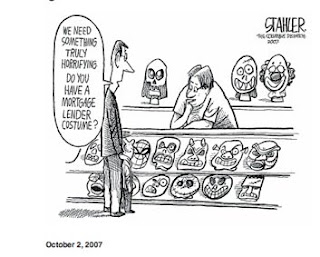
(Thanks to nationally syndicated political cartoonist and Editorial Cartoonist for the The Columbus Dispatch, Jeff Stahler, for this appropriate cartoon)

Posted in causes of the crisis, Howard Rice, jury trials, lenders, litigation, mortgage insurers, predatory lending, public perceptions, securitization, subprime, underwriting practices | Leave a comment