Way Too Big to Fail Goes to Washington (Book Tour Day 3)

After a hiatus over the holidays, I return with Part IV of this five-part series on my experiences during a recent book tour to promote the release of Way Too Big to Fail: How Government and Private Industry Can Build a Fail-Safe Mortgage System.  Use the following links to read Parts I, II, and III.
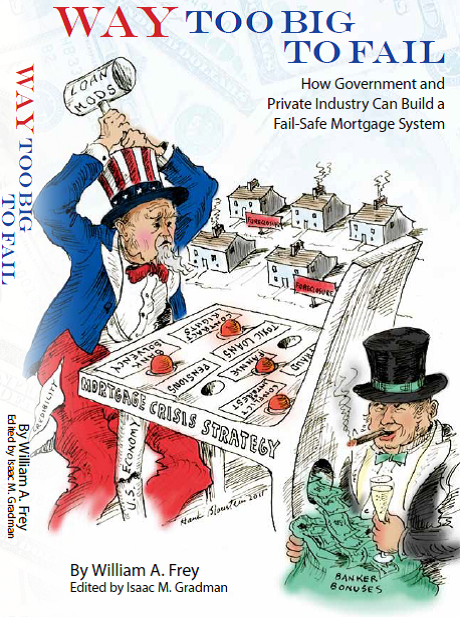
Way Too Big to Fail, by Bill Frey, ed. by Isaac Gradman

I again woke before dawn on the third day of our East Coast tour to promote the release of Way Too Big to Fail (WTBTF).  Over the last two days, author Bill Frey and I had met with numerous individuals in finance, academia and the media, but today would be different.  That’s because today we would be flying directly into the mouth of the beast—Washington D.C.—to meet with some of our nation’s elected officials.

The cover of WTBTF (see left or visit the book’s Facebook page for more detail) depicts a cartoon of Uncle Sam playing a game of Mortgage Crisis Strategy Whack-A-Mole, futilely swinging the hammer of “Loan Mods” at the various mortgage problems that pop up, while the “U.S. Economy” leg of the game’s table cracks and money flows out of the back of the machine into a bag labeled “Banker’s Bonuses.”  Suffice it to say that WTBTF’s cover does not paint the most complimentary picture of Washington’s efforts to solve the mortgage crisis, so it would be interesting to see what the folks at Capitol Hill would say when we handed them a copy.

Our flight into D.C. arrived around 8:30 AM and we jumped on the Metro to get to our first meeting of the day: with Georgetown Law Professor Adam Levitin.  Levitin was one of the few academics who consistently had been willing to speak the truth regarding the depth of the banks’ problems stemming from their subprime origination and securitization activities.

In one particularly memorable instance, Levitin was hired by Citigroup as a guest speaker and asked to give his assessment of problems associated with improper foreclosures, robosigning and broken chain of title.  The resulting report, entitled “Foreclosures Gone Wild,” was released by Citigroup despite being, in Citi’s own words, “one of the bleaker portraits of these matters and their ultimate resolution.”  It then summarized Levitin’s findings as follows:

[i]t appears that in many instances during the mortgage securitization process over the past few years, the paperwork was not properly transferred. If the paperwork was not transferred in the legally required manner, it raises  questions  not  only  about  who  owns  the  mortgages  in  question  but  also about  the  validity  and  tax  exempt  status  of  the  trusts  in  which  the  mortgages reside.

Not surprisingly, this report and it’s conclusions made waves instantly among commentators and analysts, prompting me to write that someone at Citi was likely on the Budweiser Hot Seat for having hired Levitin to be the featured guest in the first place.  Citigroup’s legal team ultimately pulled the report from the Internet, stating that it was simply standard practice to “investigate any misuse of Citi’s intellectual property,” but the damage had been done.  Interestingly, the report can still be found here and here.

I had first started talking to Levitin in early 2011 when he linked to some of my articles on Credit Slips.  Later, I asked him to read an advanced copy of Way Too Big to Fail and offer us his thoughts.  Despite his busy schedule, he had made the time to do so, and reported back that he thought the book was great.  He ultimately provided extensive feedback, both positive and constructive, as well as a blurb, which now appears on the back cover (you can read Levitin’s blurb, along with other testimonials, here).  Frey, Levitin and I had since had several productive conversations, and everyone seemed to benefit from the ongoing exchange of ideas.

I was excited to finally meet in person the man who had been willing to tell the banks what he thought, not what they wanted to hear.  I sat down in Levitin’s office at Georgetown Law Center and took a quick look around.  The décor did little to suggest that Levitin was anything other than the typical law professor.  His bookshelves were lined with legal texts and memorabilia from some of the most famous legal cases (he even had a framed certificate of original shares in Erie Railroad from the famous choice of law case Erie Railroad v. Tompkins).

Yet, Levitin was not the typical law professor, consumed solely with esoteric questions about subtle distinctions in legal interpretation or trends in Supreme Court precedent.  Levitin had a decidedly macro perspective that evinced a much deeper interest and understanding in global finance and politics than most of his peers.  And, importantly, he was not afraid to share his views on this diverse array of topics in both published papers and on the Credit Slips blog.

Today, Levitin was focused on trying to understand why Bank of America had moved its derivatives into a depository, and what this revealed about its deeper problems.  In particular, he was focused on the gap between BofA’s then-book value of about $220 billion and its then-market cap of about $70 bn.  This, he felt, could only be explained by the market’s perception that BofA had bogus assets and/or unrecognized liabilities.  But in that case, why had the bank made such a large investment in the bonds of troubled European sovereigns (the so-called PIIGS)?

Frey had a response: the banks will use these positions to hold the PIIGS, and the U.S. Treasury, hostage.  “Remember that scene in Blazing Saddles,” Frey said, “where the Sherriff comes to town and is about to be lynched because he’s black?  So he holds a gun to his own head and says, ‘Don’t make a move or the black guy gets shot!’?”  [This was the first I knew that Frey was a Mel Brooks fan.]  “That’s essentially what the banks are doing.  They’ll go to Geithner and say, ‘Now that we hold these bonds, you better bail out the PIIGS or they’ll take us down with them and you’ll have a much bigger problem on your hands.’”

This was a point that Frey had also made in WTBTF – that it was dangerous for a country to let a bank or any other entity exist without capital but with implied government backing.  Such a state of affairs could lead to reckless “double-or-nothing” type bets that, while rational for the bank, would be grossly detrimental to the country and the taxpayer in the long run.

Levitin was intrigued.  A week later, he published this article on Credit Slips entitled, “Is Bank of America Gambling on Resurrection (or Is BoA Holding the US Hostage)?  Therein, he explored further the possibility of the banks using European debt to hold the U.S. over a barrel.

That day in his office, we also spoke about Way Too Big to Fail, and Levitin offered some suggestions of other people in the industry who might benefit from reading the book or have valuable feedback.  He reiterated that he thought WTBTF was a valuable resource and that the folks in Washington should take notice, though there was no guarantee they would.  “Everyone else seems to want to stick it to the banks these days and see someone go to jail,” Levitin said.  “When will Washington get that?”

We were determined to find out.  We said goodbye to Levitin, as he was heading out to teach a first year class on contract law, and we headed to Capitol Hill.  We had a full slate of meetings planned that day with the staffs of a half dozen congressmen.  Frey had done this sort of thing before, but it was my first time, and I was apprehensive about what I might encounter.  Exactly how far behind the curve were our elected officials?

Our first meeting did little to reassure me.  We met with the “housing policy expert” on the staff of a senator who will remain nameless.  The staffer was a spitting image of Frey’s description in WTBTF of most staffers he had met while lobbying against the Servicer Safe Harbor:

[f]or those unfamiliar with the lobbying process, as I was at the time, it turns out that one rarely gets to meet with any elected officials.  Instead, each official is usually represented by a young adult with a freshly minted law degree who, while ostensibly well intentioned, is a self-described “policy wonk” with little experience in the subject matter. (WTBTF at xxxvi)

After handing the staffer a copy of our book, our first order of business was to understand how much the staffer already knew so we could decide where to start.  “You can rebuild securitization privately through reforming the standard PSA,” Frey began, “but it can be done faster and more uniformly by having the government enact certain measures that get the ball rolling in the right direction.”

“What’s a PSA?” the staffer responded.  This came as a bit of a surprise, as a housing policy expert probably should have been familiar with a Pooling and Servicing Agreement, the central contract governing a mortgage securitization.  It was then that Frey and I realized the enormity of the task that lay ahead – educating our nation’s decision-makers and their staffs about the complexities of housing finance that stood in the way of housing market recovery.

But of course, the reason that we had published WTBTF in the first place was to provide an educational tool to those who wished to improve this very system.  This necessarily involved teaching those without a background in structured finance about the history and legal underpinnings of securitization, its inherent conflicts of interest, and the steps that should be taken if it was to be rebuilt so that it survived.

Patiently, we spent the next hour explaining some of these concepts to the staffer.  At the end of this meeting, we felt fairly confident that the staffer knew far more about mortgage backed securities than he or she had going in, but we still knew we had barely scraped the surface.  This was certainly going to be no easy task, but it was one that we were excited about finally undertaking in earnest.

It turns out that most of the staffers we met that day were more knowledgeable about mortgage issues than the staffer from our first meeting, but there were still plenty of gaps in their knowledge that we felt we could fill in.  A common refrain we heard was that most congressmen had one staffer who was his or her “housing policy expert” and one staffer who was their “finance expert,” but that “housing finance” fell somewhere in between.  This was more than a little disconcerting, considering that this market was as large as $11 trillion at its peak and should hardly have been considered a niche expertise, let alone something that fell through the cracks.

Later in the day, we had the pleasure of meeting with a few staffers who understood many of the issues plaguing housing finance and the importance of rebuilding this market.  It was refreshing to speak at last to folks in Washington who were on the same page about the need for reform in this area, and who could speak intelligently about the challenges they faced in trying to do so.  While I won’t disclose their names, as I don’t want to suggest a partisan bent to this plainly bipartisan issue, I will say that this understanding of the issues is reflected in the public statements and legislation that has been authored by their offices.

It made me realize that behind every reasonably-coherent statement by an elected official on a matter of housing finance is a wise staffer or two that actually gets it.  After handing out copies of WTBTF to more than a dozen such staffers today, I’m hoping that we can at least add a few more individuals’ names to those ranks in the coming months.

Follow @WTBTF on Twitter for real time updates on the book and its impact.

Posted in Adam Levitin, bailout, balance sheets, banks, BofA, book tour, chain of title, Citigroup, conflicts of interest, Congress, foreclosure crisis, Government bailout, improper documentation, legislation, lobbying, MBS, mortgage market, negligence and recklessness, pooling agreements, regulation, Regulators, RMBS, robo-signers, Senate staffers, Servicer Safe Harbor, Timothy Geithner, too big to fail, Treasury, Way Too Big to Fail, William Frey | Leave a comment

MBIA Celebrates Bransten Decision on Loss Causation; Bondholders Still Looking for Guidance

As loyal readers will recall, I laid it on the line a few weeks back and predicted that MBIA would win its loss causation argument against Countrywide/BofA, making the nation’s largest bank wish it had settled this bellwether piece of New York litigation. Well, I was right… to a point.

MBIA and other bond insurers with MBS exposure were certainly smiling after MBIA won the majority of its claims in Tuesday’s opinion on summary judgment (the “Order”). In particular, MBIA succeeded in convincing Judge Bransten that it did not have to tie specific claims payments to particular misrepresentations in order to prove its claims of fraud and breach of contract and recover the insurance proceeds it has paid on defective loans.  “We are very pleased by today’s ruling,” MBIA Chief Executive Jay Brown said. “The ruling provides us with a straightforward path to recovery of our losses.”

However, the Judge stopped short of providing the complete relief that MBIA was seeking – to bar Countrywide’s defenses regarding intervening causes entirely. The Judge also kicked the can down the road on providing MBS plaintiffs with their first piece authority as to whether the materiality standard for mortgage putbacks required a showing that the breach in question caused the loan to go into default. Unfortunately, her Honor punted on this last (and arguably most important and far-reaching) issue, leaving bondholders without guidance on the strength of repurchase claims.

As per my MO, I will break down Bransten’s recent Order in a bit of detail. This time, I’ll include my real-time reactions from last Tuesday as I read each section of analysis in the Order.

Section 1 – Summary of Arguments on Fraud and Breach of Warranty

In this first section, Judge Bransten reiterates MBIA’s argument that in order to succeed on its claim for insurance fraud, it need only prove that the application for insurance contained a material misrepresentation that, had MBIA known the true facts, would have led it to change the terms or provision of insurance coverage.  Bransten also notes that MBIA makes a similar argument on loss causation with respect to its claims for breach of warranty in its insurance agreements: it must only prove that the breach of warranty materially increased the insurer’s risk.  Bransten then recites the counterargument from Countrywide: that MBIA must instead establish that the claims payments it made were caused directly by Countrywide’s misrepresentations or breaches of reps and warranties, and not by some intervening cause (e.g., the economic downturn, the housing market crash, or the price of tea in China).

At this point, it strikes me again how strained an interpretation of causation Countrywide/BofA is trying to sell the court.  They’re essentially saying, “we can lie all we want to induce you to insure our bonds, and our lies might actually succeed in inducing you to insure our bonds when you wouldn’t have otherwise.  But, if you can’t prove that our lies led directly to your payment of a claim, tough luck.”  I’m as confident as ever that Bransten will side with MBIA.

Section 2A – Causation

Bransten next identifies the “base issue before this court… when causation occurs in claims for insurance fraud and breach of representations and warranties.”   In reaching this issue, she must first address Countrywide’s argument that the First Department (New York’s Court of Appeals) had already held that MBIA must prove that Countrywide’s alleged wrongdoing caused MBIA’s losses.  Bransten has little trouble disposing of this argument, holding:

the court disagrees with Countrywide’s characterization of this court’s holding and the Appellate Division’s June 30, 2011 decision with regard to causation.  The Appellate Division decision did not hold, as Countrywide argues, that this court must determine which of MBIA’s losses were caused by countrywide’s alleged wrongdoing and which were caused by the “Mortgage Market Meltdown.”  Rather, in the section that Countrywide quotes, the First Department rejected Countrywide’s contention that MBIA’s fraud claim must be dismissed for failure to plead a causal link between Countrywide’s alleged misrepresentations and MBIA’s alleged damages. (Opinion at 9-10 (citations omitted))

You may recall from my article analyzing these pleadings that I didn’t see how the First Department’s decision lent any support to Countrywide’s global catastrophe defense.  Apparently, Bransten sees it the same way as she goes on to determine that no decision exists that must be treated as “the law of the case.”  So far, so good.

Bransten next turns to MBIA’s arguments that its claims under New York law are informed and influenced by New York Insurance Law Sections 3105 and 3106.  First, she holds that MBIA’s insurance law claims are valid in this action for damages and that Countrywide is the proper defendant for the misrepresentations alleged by MBIA.  The court then finds that MBIA’s common law claims are indeed informed by New York common law and Insurance law Sections 3105 and 3106.

This is a critical win for MBIA and the first sign that MBIA might score a complete victory on its motion.  Remember that the familiar understanding of materiality in the insurance context under New York common law and Insurance Law is that a misrepresentation that would have affected the insurer’s willingness to insure the risk or the terms on which it would have insured the risk constitutes a material misrepresentation.  The fact that the court will be using these sources to determine causation and materiality bodes extremely well for MBIA.

Sure enough, in the following paragraph of the Order, the court finds that, “no basis in law exists to mandate that MBIA establish a direct causal link between the misrepresentations allegedly made by Countrywide and claims made under the policy.” (Order at 14)  Instead, Bransten holds that to recover for fraud or breach of warranty, MBIA must prove only that Countrywide’s misrepresentations were material to MBIA’s decisions to issue the insurance policies, and that materiality means that Countrywide’s statements,

induced MBIA to take action which MBIA might otherwise not have taken, or would have taken in a different manner… MBIA must prove for its fraud claim that it issued the Insurance Policies on representations made in the policies’ applications, and that it would not have done so or would have issued the policies on different terms had the alleged misrepresentations not been made.  Similarly, MBIA must prove for its breach of warranty claim that Countrywide’s alleged misrepresentations materially increased MBIA’s risk of loss. ” (Id. at 14-15)

At this point, the court’s analysis has squared precisely with my own, and I am as confident as ever that the court will strike a decisive blow to Countrywide’s loss causation argument across the board.  If common law claims for fraud and breach of insurance contract reps and warranties only require a showing of a material misrepresentation, then why should putbacks require anything more, especially when the contract language is “materially adverse impact” on the insurer’s interest in the mortgage loans?

Section 2B – Rescissory Damages

Before handing down what I’m certain will be a sparkling affirmation of MBIA’s argument on putbacks, Bransten first deals Countrywide another crucial setback.  As part of its Partial Summary Judgment Motion, MBIA had sought a declaration that it could recover its alleged economic injury through rescissory damages.  Countrywide had countered that to recover under New York Insurance Law, MBIA could seek only to rescind or avoid the policies, which would be both unfair to the bondholders and barred by the provisions of MBIA’s financial guaranty policy.

Here, though there was little governing case law in New York regarding the application of rescissory damages in lieu of actual rescission, Bransten shows a surprising openness to the idea that rescissory damages may be awarded as the economic equivalent to rescisison where rescission is not practical.  After finding that rescission would indeed be impractical in this case, even though it may ultimately be warranted, Bransten finds that “rescissory damages are appropriate in this instance under persuasive case law and this court’s power to award relief.” (Order at 17-18)

To support this finding, which has MBIA and the other monolines smiling because it will provide them with the most direct and complete pathway to recovery, the court is forced to rely on cases from such diverse sources as the Delaware Chancery Court, the U.S. District Court for the Southern District of New York, and the U.S. District Court for the District of Arizona. The fact that the court is willing to broadly interpret the law and the scope of its powers in this regard, and to apply substance over form in fashioning an equitable remedy for the insurer, bodes well for MBIA’s chances on the rest of this motion.  Bransten seems to be going out of her way to ensure that MBIA has an avenue for recovering its losses.

At the end of this section called “Causation,” Bransten sums up her findings: MBIA may prove fraud or breach of warranty based upon a misrepresentation by Countrywide that induced action resulting in damages, and rescissory damages may make MBIA whole for any wrongdoing which it is able to prove.  She then writes: “However, the court does not find that this disposes of Countrywide’s fourteenth and fifteenth affirmative defenses.  The burden of proof remains upon MBIA to prove all elements of its causes of action.”

Recall that Countrywide’s 14th Affirmative Defense is that Defendants were not the proximate cause of MBIA’s losses.  Countrywide’s 15th Defense is that there were superceding or intervening causes which were the actual cause of MBIA’s losses, “including but not limited to macroeconomic and mortgage industry events.”  Based on Bransten’s other findings in her Order, that MBIA must still show proximate causation connecting the misrepresentations that induced it to issue the insurance policies and its losses, it makes sense that she would leave these defenses intact.  She certainly could have been more proactive here and barred any defenses suggesting that proximate causation must connect a policy payment and a misrepresentation, or any defenses pertaining to intervening causes that occurred after MBIA insured the policies, but I can understand that Bransten would want to stick to addressing MBIA’s particular request to bar the defenses entirely, and not go too far afield.  I still have little inkling that all is not rosy in Loss Causation Land.

Section 3 – MBIA’s Claims for Breach of the Repurchase Obligation

Finally, the moment I have been waiting for.  I have been saying for years that insurers’ and bondholders’ putback claims were relatively strong because the standard was “materially adverse impact” rather than “proximately causes loss.”  Since this is the first post-crisis MBS case to reach this question, it’s the first real guidance we’ll have on a critical and far-reaching issue in MBS litigation.

Yet, if I was hoping that Bransten would come right out of the box with an answer, I was sorely disappointed.  Instead, the court takes the next five pages to lay out in excruciating detail each side’s arguments on this issue.  Her Honor had summed up the parties’ arguments in the prior sections with a few sentences or a paragraph at the most.  The fact that Bransten is now going into this much detail in recapping the same arguments we’ve read in the pleadings and heard at oral argument sets off alarm bells in my head: the court is setting up a genuine dispute of material fact.

You see, summary judgment is only appropriate if there is no genuine dispute of material fact; that is, looking only at the facts agreed upon by both parties, it is apparent to the court that judgment must issue for one side or the other.   Contractual disputes are usually particularly well-suited for summary judgment because the parties agree that the contracts are the contracts, and the court is thus left to interpret the contracts and the parties’ intent based on the plain language of their written agreements.

Summary judgment seems especially appropriate here in MBIA v. Countrywide, as we have heard little about any oral agreements or other facts outside of the four corners of the contracts that might inform their interpretation.  Thus, I would have expected Bransten at this point to be running through her analysis of the contractual language on putbacks, not the parties’ arguments.  The fact that she’s instead spending pages rehashing the parties’ interpretations feels distinctly like a football team running a draw play on 3rd and 14 – they’re playing it safe and preparing to punt.

Sure enough, at the bottom of the fifth page of recap, Bransten finally reaches her conclusion.  Noting that “MBIA has posited a strong argument,” she nonetheless finds that “summary judgment is not here appropriate.” (Order at 23)  Her reasons?  MBIA only cites contract language from one of the 15 MBS Trusts, and though it states that a similar repurchase remedy exists across all 15 trusts, it hasn’t sufficiently laid out the contract language for those 15 trusts in its Rule 19-a statement of material facts.  Then, as if it was an afterthought, Bransten throws in an extra sentence about how the words “interest” and “aggregate” in the contracts are subject to varying interpretations.

Suddenly, Bransten has gone from flexible rulings, bending to give MBIA a pathway to recovery, to strict rulings that rely on technicalities for support.  Yes, technically, the particular facts upon which a party wants the court to rely must be laid out in its statement of facts.  But, must MBIA go through and lay out the relevant contract language from multiple sections of every one of 15 trusts?  Isn’t it sufficient for MBIA to provide a sample and to state that this is representative of the other contracts – a fact that can be verified from the record?

Keep in mind, this is the same judge that approved statistical sampling to present loan-level evidence because the court did not want to spend the time going through every one of the 300,000+ loans at issue.  Wasn’t it reasonable for MBIA to assume that this judge would not want to see 15 separate factual statements for each trust?  Moreover, if Bransten had wanted to rule on this issue, she certainly could have had her clerk go through the pertinent sections of the various Trust Agreements (which are presumably part of the record) and determine whether there was any relevant difference in their language.

Similarly, relying on the fact that there are “varying interpretations” regarding the word “interest” without making any value judgment about the strength of those interpretations falls short of the judicial diligence I expected.  There will always be varying interpretations of any contract in litigation.  It is entirely within the court’s province to decide which one most closely effectuates the intent of the parties.  This is especially true when Bransten has just called MBIA’s argument “strong.”  Heck, she just walked through the case law providing that insurers are entitled to know the nature of the risks they’re assuming.  How difficult would it have been to find that an insurer’s interest in the loans is the same as its interest in the policies – the riskiness of the asset it was insuring?  All told, this portion of the Order feels distinctly like a cop-out – the judge guided us 3/4 of the way across a rickety rope bridge, and had everything she needed to get us to the other side, but for some reason stopped short and told us “good luck!”

Loss Causation Fallout

Of course this decision, and the mirror-image decision Bransten issued in the case of Syncora v. Countrywide, et al., do provide the monolines with fodder that they can use in their ongoing MBS cases.  But applying this decision to bondholder cases will be more of a stretch.  Shortly after reading the opinion, I tweeted, “J. Bransten goes 3/4 of way toward giving MBIA & Syncora complete wins v. BofA on MSJ but stops short of applying same reasoning to putbacks.”  Soon, a response came from Scott Walker (@scottleewalker), a litigator in the Structured Finance group at Lowenstein Sandler: “@isaacgradman — I had the exact same thought. Have been waiting for some guidance in that area. Oh well.”

All of which raises the immediate question: why did Bransten stop short?  I have a theory, but obviously this is just speculation on my part.  By way of the first 3/4 of the Order, Bransten provided MBIA with a shorter, cheaper and more complete pathway to recovery than putbacks by allowing it to seek rescissory damages.  Now, instead of having to go loan-by-loan (at least through a sample of some 6,000+ loans), and being able to recover only those losses on loans it can prove were defective, MBIA can just prove that it was induced to issue the policies by a misrepresentation and thereby recover all of its losses.

Maybe Bransten hopes that MBIA be happy with that decision (they were), not appeal her on putbacks (still an open question) and opt to go down the fraud and breach of insurance contract paths exclusively, saving Bransten one huge headache of a trial.  Or at least she hopes that by providing MBIA this weapon in its arsenal, it will make BofA more likely to settle.

Bransten also made several comments on the record during oral argument on this motion recognizing the unique attention this case was attracting and the impact it would have.  She stated,

It is a very full courtroom so we’re going to have a few things that we have to talk about before I even address my attorneys here today. In the first place, I have my other attorneys sitting the jury box, am I right? Okay. Usually I wouldn’t permit any standing room. However, I understand that this has a major impact on lots of people and some people didn’t get here quick enough to get a seat, so if there is an empty seat anywhere I want it filled and we can squeeze as much as we can, that’s number one.

Number two, the strict rule that I will enforce is I do not want anyone to speak during any of our arguments. We have to be absolutely silent. For those of you standing, the only thing I can say is if you get uncomfortable or you want to speak or you have anything to say, just go outside and do it. I think from now on, this is it. I think we have reached maximum capacity, so that will be it. Anybody who is here, if we take a break and come back, no new people, because I really do think that we’re maxed out. (Transcript, Oral Argument on MBIA’s Motion for Partial Summary Judgment at 3:2-22 (emphasis added))

These comments certainly don’t give me the impression that Bransten presides over cases with this much national interest very often.  With this decision, Bransten avoids the spotlight on appeal and possibly avoids having to try this dog of a case.  Let’s be clear: as an analyst following these issues, I find this case fascinating and important, but to a state court judge, a case dealing with hundreds of thousands of loans and 15 complex mortgage securitizations that has taken 3 years just to get this far is probably beginning to look distinctly dog-like.

So maybe she was hesitant to stick her neck out, risk getting overturned on appeal, and at the very least have her opinion bandied about in every MBS case in the country.  I get it, but part of me was hoping that Bransten would be inspired by the judicial courage shown recently but Jed Rakoff and put to rest an issue that IMHO was plenty ripe for determination.

Posted in appeals, banks, BofA, bondholder actions, broader credit crisis, causes of the crisis, contract rights, damages, investors, Judge Jed Rakoff, Judicial Opinions, lawsuits, liabilities, litigation, loss causation, MBIA, MBS, misrespresentation, monoline actions, monolines, pooling agreements, private label MBS, putbacks, rep and warranty, repurchase, rescission, RMBS, securitization, statistical sampling, The Subprime Shakeout | 5 Comments

Federal Home Loan Bank Litigation Update: MBS Cases Moving Slowly, But Steadily, Ahead for FHLBs

By Isaac Gradman and India Autry

The Federal Home Loan Bank (FHLB) litigation against MBS underwriters, some of the first to arise out of the sale of toxic mortgage backed securities post-crisis, is progressing slowly but surely towards trial, without any major setbacks for the plaintiffs. As these suits have been followed closely since their inception by The Subprime Shakeout and its readers, and since it’s been a year since our last article on this front, we thought it was a good time for an update.

In the first of the six FHLB suits, brought by the Pittsburgh Bank, discovery is well underway and the court has ordered defendants to turn over extensive loan files. As previously reported on The Subprime Shakeout, the Bank’s complaint initially withstood dismissal without much hard evidence of wrongdoing, most of which could only be found in loan files that defendants and servicers had not been willing to turn over.  Now that the bank is beginning to obtain loan files, one can only imagine what other evidence and/or claims of wrongdoing they will find.

The plaintiffs in the other FHLB suits are just now reaching the beginning stages of discovery, having overcome their defendants’ respective motions to dismiss.  At the outset of most of these suits, the defendants employed the common tactic of removing the cases to federal court, in an effort to prolong the cases and drive up costs for the plaintiffs. Though the FHLBs of San Francisco, Seattle and Indianapolis have since been successful in having their cases remanded back to state court (to be heard by judges presumably more likely to broadly construe their own states’ Blue Sky laws), defendants have succeeded in delaying these cases for years.  Motions to remand still are pending in the cases brought by the FHLBs of Chicago and Boston.

The good news for plaintiffs in these cases is that defendants’ motions to dismiss largely have failed.  We’re going to dive into the Order on Defendants’ Motion to Dismiss in Seattle as an example.  In that case, Washington state judge Laura Inveen shot down, on all but one issue, the consolidated motion of the eleven defendants that sought to dismiss the FHLB’s claims.

The Seattle Bank had asserted claims against the defendants pursuant to the Washington Blue Sky law allowing for rescission based on false or misleading statements.  In particular, the FHLB focused on four types of misrepresentations in the MBS Prospectuses, which have since been repeated verbatim by the FHFA in its later-filed suits:

  1. Misreps regarding loan-to-value (LTV) ratio;
  2. Misreps regarding borrowers’ intent to occupy properties as primary residences;
  3. Misreps regarding originators’ and underwriters’ adherence to their own guidelines; and
  4. Misleading statements regarding the ratings of the certificates.

The defendants countered that the court must dismiss these claims for a number of reasons:

  1. The statements were just opinions;
  2. The statements were actually non-actionable statements of third parties;
  3. The trust documents contemplated the repurchase of non-performing loans, so the statements in the prospectuses could not have been considered absolute; and
  4. The Prospectuses contained sufficient disclaimers to warn investors not to trust the statements or the loan quality.

The court ended up denying the defendants’ motion to dismiss as to each of plaintiffs’ categories of alleged misrepresentations, with the exception of borrowers’ statements regarding their intent to occupy the premises as a primary residence (more on that below).  The court pointed out that the standard for a motion to dismiss was high, especially since there were no allegations by the plaintiff of fraud. Also, the court refused to conduct a choice-of-law analysis, which would have resulted in the application of New York law with its more limited protections, since Washington’s Blue Sky laws provided investors greater protection than New York’s, and the court found that the state of Washington had a sufficient nexus to the litigation to apply its own law.

The court then addressed defendants’ arguments that the allegations of false and misleading statements were non-actionable opinions or statements of third parties. With respect to three out of the four categories of alleged misrepresentations (LTV, guidelines and ratings misreps), the court found there was enough verifiable information to make the material actionable and that the defendants sufficiently restated third-party statements and adopted them as their own, such that dismissal was not appropriate. As to the allegation regarding intent to occupy, however, the court held that,

Plaintiff was aware that occupancy assertions were based solely on the say-so of the borrower — an individual with a pecuniary motive to obtain a loan, with little, if any risk in being deceptive when misstating the occupancy status to obtain a favorable rate and terms. As a matter of law, it was not reasonable for Plaintiff, the sophisticated investor that it was, to rely upon statements about occupancy. (Order at 4)

This finding is notable, not so much because it rejected this category of misrepresentations – which seemed to be the weakest of the four categories – but because it pointed to the sophistication of the investors as one reason for dismissal.  As discussed previously on The Subprime Shakeout, investor sophistication has been widely cited by defendant banks as a defense in MBS securities suits, and this argument is being pounded especially hard in cases where the investor was the presumably sophisticated Freddie or Fannie.

However, federal securities laws do not seem to allow for this consideration.  Washington Blue Sky laws may be different, but the court does not cite to any case that so holds, so it’s not clear whether this opinion is an anomaly or whether other judges will follow this reasoning.  Note also that Judge Inveen held that information regarding intent to occupy could still come in to prove other allegations, such as failure to adhere to underwriting guidelines.

Finally, as to defendants’ argument that there was sufficient qualifying language, such as disclaimers, in the underlying agreements, such that the investors should have been on notice that some of the loans would not turn out as described, the court ruled that this language was either not applicable to the loans at issue, was not specific enough, or amounted to issues for a trier of fact to decide.

We tend to think that unless there were disclaimers in the Prospectuses that “the underlying loans will be approved without regard for the borrower’s ability to repay, no matter how bad the credit risk appears,” the boilerplate language that “exceptions to the guidelines will be permitted where compensating factors are present” does not exempt issuer banks from liability.  Exceptions were meant to be exactly that – occasional deviations from the guidelines – and the Prospectuses, as well as the originators’ underwriting guidelines themselves, generally provided that any exceptions had to be documented and supported by compensating factors.  The practice of simply ignoring ones own underwriting guidelines for no good reason (except profit) was neither permitted by the guidelines nor disclosed to investors.

At the end of the day, Judge Inveen’s holding bodes well for the Federal Home Loan Bank cases and the securities law claims of other MBS investors.  You can expect these cases to continue moving forward, and to begin settling or finding their way to their courts’ respective trial calendars sometime in the next year or two.

Posted in banks, Blue Sky laws, choice of law, discovery, Federal Home Loan Banks, investors, lawsuits, litigation, loan files, LTV, MBS, misrespresentation, motions to dismiss, ratings agencies, remand, removability, securities fraud, securities laws, securitization, sophistication, subprime, underwriting guidelines, underwriting practices | 8 Comments

Rakoff’s Rejection of SEC Settlement with Citi Sends Stern Message to Wall Street’s Primary Regulator

Two days after the release of one of the most scathing judicial opinions in recent memory, the importance of federal Judge Jed Rakoff’s rejection of the SEC’s $285 million settlement with Citigroup is just beginning to sink in.  In just 15 pages of moving prose that harken back to Rakoff’s undergraduate degree in English literature, the opinion rips the SEC for its lack of transparency and respect for separation of powers, failure to establish facts or allegations against Citigroup or deter future misconduct, and failure to uphold its obligation to uncover the truth and protect the public at large from financial fraud.

As Matt Taibbi of Rolling Stone magazine most aptly describes the opinion in his article, Federal Judge Pimp-Slaps the SEC Over Citigroup Settlement, it was “one of the more severe judicial ass-whippings you’ll ever see.” The ruling prompted Tyler Durden at ZeroHedge to call for the resignation of SEC Chairman Mary Shapiro. Below is an entertaining clip of Taibbi discussing the impact of Rakoff’s ruling on Countdown with Keith Olbermann.

So, what is the gist of Hizzoner’s objections?  First off, Judge Rakoff points out that in a parallel complaint filed by the SEC against a Citigroup employee for his role in putting together the CDO at issue, the SEC alleged that 1) Citi created Class V Funding III (the “Fund”) to dump dubious assets on misinformed investors as the market was tanking, 2) Citi helped select and then took a short position in the assets placed in the Fund, and 3) Citi knowingly misrepresented to investors that the assets had been selected by an independent third-party investment adviser in order to place the Fund’s liabilities. Rakoff notes that while these allegations would be tantamount to a showing of knowing and fraudulent intent (the scienter necessary for a fraud claim), the SEC left many of them out of the complaint against Citigroup itself and chose to charge Citi only with negligence (i.e., a failure to exercise due care rather than an intentional lie).  That was the first sign of a problem.

Next, Rakoff points out that through its complaint, the SEC seeks to invoke the court’s injunctive powers – an extraordinary remedy – without having proven any facts or coerced an admission of wrongdoing out of Citi.  By contrast, the SEC’s settlement with Goldman Sachs over the Abacus CDO required the bank to admit to “a mistake” and to “regrets” that the marketing materials for the CDO were inadequate.  This opened the door for civil lawsuits to further deter the bank from misleading investors in the future.  With respect to the Fund, the Judge noted that Citi made clear in open court that it was not admitting to the allegations in the complaint and reserved the right to contest the facts in parallel litigation.

Based on this, Rakoff found that the court was unable to determine whether the settlement was “fair, reasonable, adequate, and in the public interest.” (Opinion at 4)  In particular, Rakoff held that,

a court, while giving substantial deference to the views of an administrative body vested with authority over a particular area, must still exercise a modicum of independent judgment in determining whether the requested deployment of its injunctive powers will serve, or disserve, the public interest.  Anything less would not only violate the constitutional doctrine of separation of powers but would undermine the independence that is the indispensable attribute of the federal judiciary. (Id. at 4-5)

Next, Rakoff takes issue with the size of the penalty imposed on Citigroup and its impact in deterring future misconduct.  In one of the more remarkable passages from the Opinion, Rakoff notes that,

a consent judgment that does not involve any admissions and that results in only very modest penalties is just as frequently viewed, especially in the business community, as a cost of doing business imposed by having to maintain a working relationship with a regulatory agency, rather than as any indication of where the real truth lies. (Id. at 10)

Rakoff is pointing out in no uncertain terms what Taibbi, filmmaker Charles Feguson, and many in the Occupy movement and elsewhere have been saying for some time – Wall Street continues to look at law enforcement as simply the cost of doing business and will not be deterred from illegal conduct unless the size of the penalties increases dramatically or people start going to jail. Essentially, Rakoff is saying that Wall Street has become accustomed to paying off the SEC when it gets caught.

Rakoff further underscores the inadequacy of the penalties imposed on Citi in this proposed settlement by comparing it to Goldman’s Abacus settlement – which itself has been criticized as inadequate, since it punished Goldman for only one of several CDOs that were marketed in the same manner.  Rakoff points out that in the Abacus deal, Goldman only made $15 million in profits (compared to the $160 million in profits for Citi from the Fund deal) and that Goldman’s alleged conduct was arguably less blameworthy as Goldman didn’t directly short the assets in the CDO, but just failed to disclose that Paulson & Co., which had helped select the assets, was also shorting the deal.  Yet compared to Citi, Goldman was required to pay a bigger penalty ($535 million as opposed to a $95 million penalty for Citi), admit to certain mistakes, implement broader remedial measures, and cooperate with authorities.  (Opinion at 13 n.7).  It’s thus not surprising that Rakoff was unable to conclude that the Citi settlement was fair, reasonable, or adequate.

Finally, Rakoff reserves his most biting criticism for the SEC itself in failing to uphold its mandate.  After noting that this case “touches on the transparency of financial markets whose gyrations have so depressed our economy and debilitated our lives,” Rakoff writes that,

the S.E.C., of all agencies, has a duty, inherent in its statutory mission, to see that the truth emerges; and if it fails to do so, this Court must not, in the name of deference or convenience, grant judicial enforcement to the agency’s contrivances. (Id. at 15)

With that, Judge Rakoff rejects the settlement and orders the parties to prepare for trial on the SEC’s complaint on July 16, 2012.

I was left with chills after reading through the end of this Opinion.  It was if I had been waiting for years to hear a member of our judiciary stick out his or her neck to confront the inadequacy of the SEC’s long established “enforcement” patterns – slaps on the wrist, no admissions of guilt and certainly no jail time.  Indeed, while the cozy relationship between the SEC and Wall Street (with most at the SEC either having worked on Wall Street or harboring aspirations to work on Wall Street in the future) has been called out repeatedly by journalists, writers and commentators, I had never heard a member of the judiciary stick out his or her neck in such a bold manner and confront the SEC.

But Rakoff’s frequent reference to the core principles of the Constitution and the independent judiciary, as well as his reference to “much of the world, [where] propaganda reigns, and truth is confined to secretive, fearful whispers,” (Opinion at 15) reveal just how important this issue was to the fundamental values that set the United States apart.  Still, it took tremendous courage for Rakoff to speak out in the face of pressure from such a powerful government agency and refuse to simply wield his rubber stamp like so many of his peers had done before him.  Rakoff is correct – passive judicial acceptance of these sorts of bargains (even between two willing parties) does not protect the public interest one iota.  In fact, it does worse, by essentially ending the inquiry and withholding from the public the facts it needs to enforce its rights or recover its losses.  As Rakoff points out, there is no guarantee that the money recovered by the S.E.C. by way of such settlements (including the $154 million recovered from J.P. Morgan in connection with the Magnetar deal) will actually go to reimbursing defrauded investors.

If we hope to restore confidence in the U.S. financial system and attract private investment, we need to begin by showing those investors that the rule of law will be enforced with more than a wink, a nod and a slap on the wrist.  I hope that Rakoff’s opinion gives more members of the bench the courage to stand up and declare that their rubber stamps for agency actions are out of commission.

Posted in abacus, banks, CDOs, Citigroup, Complaints, consitutionality, costs of the crisis, damages, Goldman Sachs, investigations, investors, JPMorgan, Judge Jed Rakoff, Judicial Opinions, lawsuits, liabilities, litigation, media coverage, negligence and recklessness, oversight, Paulson and Co., probes, regulation, Regulators, SEC, securities laws, settlements, Uncategorized | 1 Comment

MBS Litigation Update: Why BofA Will Lose the Loss Causation Argument and Wish It Had Settled with MBIA

With all eyes in the mortgage litigation world glued to the pending decision on Partial Summary Judgment in MBIA v. Countrywide, et al., commentators are beginning to speculate that a settlement may be in the offing between the two MBS heavyweights.  However, as we get closer to a decision on MBIA’s fully briefed motion with each passing day, and as BofA continues to suffer heavy casualties with each stroke of Judge Eileen Bransten’s pen, the nation’s largest bank by total deposits is running out of time to avoid another potentially disastrous result.

Indeed, rumors were already swirling as early as this past July that BofA had settled this lawsuit, sending the bond insurer’s stock soaring, but all gains were quickly erased as the market recognized the news as exactly that – just a rumor.  Then, last month, another rumor emerged that again reported that a settlement was in the works, and this time the rumor revealed a purported price tag for this settlement – $5 billion.

Of course, every rumor contains a kernel of truth, and this one made sense – given the devastating precedent this lawsuit could set for BofA, it must be carefully considering, and is likely in the process of discussing, a settlement with MBIA.  This past week, in fact, BofA reportedly settled a class action suit regarding Merrill Lynch securities to the tune of $315 million (interestingly, this settlement was first reported by Alison Frankel, who has also been suggesting that an MBIA settlement may be forthcoming).  If this report is true, could a settlement with one of the most dogged and successful plaintiffs in the slew of MBS suits against BofA be far off?

Having already suffered tough-to-swallow losses on the issues of statistical sampling, scope of discovery, fraud claims and successor-in-interest liability, BofA is now facing an even more significant loss.  At risk if BofA does not settle quickly is an adverse decision on the causation standard to be applied to putback claims – one of the key defenses cited by the bank (and by Bank of New York in justifying its settlement number on behalf of BofA) in maintaining that its obligations to repurchase defective subprime and Alt-A mortgages will be contained.

Aside from BofA’s string of losses before Judge Bransten, all signs from a legal perspective point to MBIA winning its Motion for Partial Summary Judgment on the issue of whether it can exclude BofA’s post-closing defenses (i.e., that the housing downturn, not Countrywide’s poor underwriting, caused MBIA’s losses) and focus on whether reps and warranties were breached at the time of the MBS Trusts’ closing.  But with this motion having been fully briefed for over a month, it seems that if BofA was going to head off this loss with a settlement, it would have done so by now.  So, assuming that this case does not settle in the next few weeks, I’m going to tell you why the next decision in this case – in one of the earliest-filed pieces of mortgage crisis-related litigation – will produce more bad news for the beleaguered Big Four Bank.

Loss Causation Background

For readers unfamiliar with the issues at stake, we’ll start with a little background.  Countrywide, in conjunction with dozens of other subprime and Alt-A originators, sold trillions of dollars worth of loans to Wall Street during the 2000s and provided the purchasers with certain guarantees – known as reps and warranties – regarding the quality of the loan underwriting they would employ and the loan guidelines they would follow.  The purchase and sale contracts for these loans specified that if any of these reps and warranties were breached with respect to a particular loan, and the breach materially and adversely impacted the value of the loan or the interest in the loan of the investor or bond insurer, the originating bank would have to buy back the loan at par (the original face value).

Though this description of banks’ so-called putback liability is noncontroversial, a major dispute has emerged over what is meant by “material and adverse impact.”  Countrywide/BofA, along with many other banks with legacy loan origination liability, has argued since these MBS lawsuits were first initiated that the “material and adverse” language created essentially a loss causation standard.  That is, plaintiffs were required to prove that each breach of reps and warranties identified actually caused the loan to go into default.

Plaintiffs like MBIA, on the other hand, have argued that the standard means what it says – that the breach has to simply impact the value of the loan by making it riskier and more likely to default.  They point to several provisions of standard Pooling and Servicing Agreements (the contracts governing the creation of MBS) that provide specifically for situations in which performing loans are required to be bought back.

You would think that the presence of provisions allowing for the repurchase of current loans would end this discussion – but BofA and other banks with repurchase liability have continued to argue this point.  I will run through each of these arguments in turn – as detailed in Countrywide’s Opposition to MBIA’s Motion for Partial Summary Judgment – and explain why none of them hold water.

Countrywide’s Loss Causation Arguments

Countrywide spends the first three-plus pages of the loss causation section of its memorandum making the unremarkable point that a breach of rep and warranty must have a material and adverse impact – that a breach alone is not enough.  This amounts to the quintessential straw man argument: Countrywide sets up a flimsy characterization of MBIA’s argument only to batter it into the ground.

It accomplishes this by seizing on one admittedly imprecise line in MBIA’s Motion, that “MBIA may invoke the repurchase provisions upon showing that the characteristics of a loan was [sic] not as represented by Countrywide” (Motion at 22), to suggest that MBIA is denying the existence of a materiality requirement.  Yet Countrywide ignores that in the very next sentence of its brief, MBIA states that Countrywide’s repurchase obligation is triggered “if MBIA’s interest in the loans is ‘materially and adversely’ affected by Countrywide’s breach…[meaning there is a] material increase in the risk profile.” Id. I doubt that Judge Bransten will have much patience for the creation of a dispute where none exists.

Assuming that both sides agree that the contract says what it says, and that it includes the “materially and adversely impacts” language, Countrywide is left with three arguments that are far flimsier than any straw man it set up for MBIA.  First, it attempts to counter MBIA’s argument that other provisions of the PSA expressly provide that non-defaulted loans may be put back to the originator.  To this, Countrywide responds that nothing in those provisions undermines the fact that a breach must “materially and adversely impact” the insurer’s interest in the loans. (Countrywide Opp. at 20)  Of course, this is true, but not if Countrywide’s interpretation of the materiality provision is that the breach must cause the loan to go into default.

Countrywide states that the PSA does contemplate the repurchase of performing loans, but only in “very limited circumstances… which are not at issue here.” (Countrywide Opp. at 20)  Again, that’s not the point.  The point is that if the PSA contemplates the repurchase of performing loans, then the “materially and adversely impacts” language cannot possibly mean that the breach must cause the loan to go into default, because that would create a contradiction, which courts are expressly instructed to avoid in interpreting contracts.  Thus, even if the circumstances under which performing loans can be put back are not present here, the presence of that language authorizing repurchase of performing loans undermines Countrywide’s interpretation of the governing contract.

Countrywide follows up this red herring with an argument that couldn’t beat its way out of a wet paper bag.  Essentially, it argues that MBIA’s insistence that a materially adverse impact could consist of an increase in the risk profile of the loan ignores the “plain meaning” of the contract language.  It then launches into an etymological exploration of the word “affects” that would have made Webster proud.  Because, according to Countrywide, “affects” means “to produce a change in,” then the breach must have actually caused harm to MBIA. (Opp. at 21)  A breach that makes the loan riskier is simply a potential adverse impact, and not an actual one, according to Countrywide.

This argument ignores the concept of risk entirely.  I’ll illustrate with a brief hypothetical.  Say we’re playing a card game where we’re betting on whether the next card you draw will be black or red.  You put up even money that the next card will be red.  When you’re not looking, I remove 5 red cards from the deck.  Now, I present you with the deck and ask you to pick a card.

Let’s freeze it at the moment before you draw.  Now, have I caused any direct harm to you?  Well, you haven’t actually lost any money yet, so technically there’s no “loss” and under Countrywide’s argument, no direct harm.  But, I have certainly adversely impacted your interest in our transaction, as I have made it more likely that you would draw a black card.  In this case, you would be justified in arguing that I harmed you by making it more likely that you would suffer a loss.  It makes no difference whether you end up drawing a red card or a black card once the game resumes.

In my mind, the argument over reps and warranties is identical to this scenario (or, if you don’t like that analogy, try the one often used by MBS plaintiffs attorneys – if the brakes on your car are defective, you don’t need to wait to get into a car accident to return the car to the dealer).  Countrywide has (allegedly) ignored its underwriting guidelines and issued loans without screening for certain risk factors (such as excessive debt-to-income ratios, inflated appraisals, inflated borrower incomes, etc.).  Now, even if Countrywide “got lucky” on these loans and some are still performing, the fact that nobody checked the borrower’s characteristics or ignored red flags means that those loans are more likely to default sometime in the future.

MBIA is essentially drawing from a stacked deck and will be forced to pay insurance claims based on how many black cards it draws going forward.  This certainly constitutes a material and adverse impact on the loans, notwithstanding whether or not it has actually resulted in a loss.  In other words, this argument conflates actual loss with actual adverse impact, and thus it is Countrywide, not MBIA, that is seeking to change the plain meaning of the pooling and servicing agreements.

Moreover, as MBIA is quick to point out, it is a familiar understanding of materiality in the insurance context that a misrepresentation that decreases the insurer’s willingness to insure the risk, or insure the risk at a particular price, constitutes a material misrepresentation.  Insurers, in other words, are entitled to know the nature of the risks they are assuming, and may avoid a policy based on a misrepresentation as to a risk, even if that particular risk does not materialize.

In further support of its “plain language” argument, Countrywide states that the First Department of the New York State Appellate Courts has already rejected MBIA’s risk profile argument in an appeal related to this very case. (Opp. at 21)  If true, this would certainly be an important fact, but alas, it’s yet another creative presentation of the truth by Countrywide’s attorneys.  You see, what the First Department actually did was affirm the lower court’s denial of Countrywide’s motion to dismiss MBIA’s fraud claim.  Countrywide had argued that the housing downturn was an intervening cause of MBIA’s loss, and thus MBIA could not as a matter of law make out its fraud claim, which requires a showing that its losses were caused by Countrywide’s fraud.  The appellate court simply held that it could not establish as a matter of law that the housing downturn was an intervening cause – that this would be a factual determination for the trial court.  How this translates into support for Countrywide’s argument that the contract language requires that actionable breaches must actually cause loan defaults is beyond me.

Finally, Countrywide adopts the familiar contract dispute refrain that adopting MBIA’s interpretation would render certain contract language “meaningless.”  (Opp. at 22)  The argument goes that a breach that adversely impacts the loan’s risk profile is nothing more than a “material breach,” thus rendering the language “adversely impacts” meaningless.  Yet, if the language simply stated a “material breach,” it could refer to a breach that was material to any number of participants or factors, such as material to the originator’s ability to sell the loan, the issuer’s ability to securitize the loan, or the servicer’s ability to service or modify the loan.  Instead, the language specifies that the breach must materially adversely affect the investor’s or the bond insurer’s interest in the loan.  The language thus specifies that the breach must impact the risk that the loan will not be repaid.  Thus, MBIA’s interpretation gives meaning to the entire clause, and would not render any language in that clause meaningless.

Countrywide goes on to cite a number of cases that employ a “materially adversely impacts” standard to the breach of a rep and warranty.  None of these holds that a breach that causes a loan default is required to satisfy this standard.  For example, Countrywide cites LaSalle Bank, N.A. v. Citicorp, 2002 WL 181703, at *3 (S.D.N.Y.) for the proposition that “a plaintiff states a claim for breach of a repurchase agreement when it has alleged a causal link between the breach of a representation and warranty and the defaulted loan.” (Opp. at 23) Essentially, that case said that if a breach causes a default, it constitutes a material adverse effect.  It did not say that a default was the only material adverse effect that would qualify.  Instead, just one paragraph later, when addressing a separate breach of reps and warranties, the court in LaSalle held that:

a determination of materiality is a fact-intensive matter.  These factual issues relate to whether the breach was material and whether any breach had a material adverse effect on the value of the mortgage loan. (Id. (emphasis added))

Need I go on?  At this point, I feel like I’m just piling on.  Suffice it to say that none of Countrywide’s cases hold that a default is the only permissible evidence of a material adverse impact.  It’s not that Countrywide’s attorneys are doing anything wrong by making these arguments – it’s just that they have been asked by their clients to defend a position that is not supported by the documents or the law.  In fact, the best thing that Countrywide has going for it is that there is very little case law directly on point.  The best case that MBIA can offer is Wells Fargo Bank v. LaSalle National Association, 08-CV-1125, a case governed by Oklahoma law, rather than New York law. This does not mean that Judge Bransten will be unable to interpret the plain meaning of the governing contracts – this is something that judges do quite often and with competence, even when the case law is unsettled.

MBIA’s Loss Causation Counterarguments

At the end of the day, MBIA’s best argument – other than the plain language argument – is that other provisions of the contracts provide expressly for the repurchase of performing loans.  Though they could have done a better job of hammering this point home in their briefs, MBIA’s attorneys made the argument a central point during the hearing before Judge Bransten, which is worth quoting at length:

So the important point here is [Section 2.10 of the Sales and Servicing Agreement] says that with respect to any mortgage loan that is not in default, so it is performing, no repurchase pursuant to Sections 2.02, 2.03 and 2.04 shall be made unless you get that tax agreement.  Now, Section 2.04, which you’ve also just been shown, is the law that contains the material and adverse language. What 2.04 says, in order to have a breach of this section, this section is not breached unless there is a showing of material and adverse affect.

So if you put these two clauses together, by referring to 2.04 and 2.10, what they are saying is that… you can put-back a performing loan that is in breach of 2.04 if you get this tax opinion, and in order to put-back the performing loan under 2.04, you have to show that it had a material and adverse affect.

When you put those two things together, your Honor, you have to come to the conclusion that what this contract necessarily says is that material and adverse is measured at the time that the transaction occurred. It cannot be measured based on whether a loan defaulted or not because, of course, performing loans which you can put-back and which could have a material and adverse affect, performing loans are never defaulted, and therefore the contract cannot as a matter of logic mean what Countrywide says it means. (October 5, 2011 Transcript at 40:7-41:6)

What MBIA also has going for it is the logical appeal of its interpretation. As illustrated by the stacked deck and the faulty brake hypotheticals, it can’t be the case that Countrywide could engage in the shoddiest underwriting in history, but get away with it if the loan still somehow performed.  There are plenty of examples in the law of scenarios in which parties are found liable for dangerous, illegal, or improper conduct pursuant to a contract, even if such conduct does not result in direct harm (think about attempted robbery, possession of a machine gun or driving under the influence, to name a few).

I could go on, but I think Philippe Selendy, MBIA’s lead attorney from Quinn Emanuel, said it as well as anyone, so I will just end this section with a quote from his oral argument before Judge Bransten:

The housing crisis does not give Countrywide a defense to its Day One misconduct and its misconduct leading into these transactions. There would be no insurance policies and no losses but for that fraud… When you think about it, what Countrywide is trying to do here, having first caused the housing crisis, together with other reckless loan originators and underwriters, they want to turn around and profit from it again. They want you to rule that the crisis is in effect a Get Out of Jail Free card that allows them to escape liability for their fraud and shift the costs to innocent parties. Well, luckily we’re in a country governed by the rule of law, and the law doesn’t work that way. (October 5, 2011 Transcript at 35:4-25)

Loss Causation Fallout

I don’t mean to belabor the point here, but I want to make it crystal clear what a bad position BofA has backed itself into.  For years, it has been telling its shareholders and regulators that its exposure to private label putback liability will be circumscribed, based in large part on this loss causation argument.  Take CFO Chuck Noski’s statement on BofA’s earnings call back in Q3 2010:

We believe many of the losses observed in these [private label] deals have been, and continue to be, driven by external factors, like the substantial depreciation in [home] prices, persistently high unemployment and other economic trends, diminishing the likelihood that any loan defect should one exist at all, was the cause of the loan’s default.

Or take the statement of Bank of New York’s “independent expert” in substantiating the $8.5 billion settlement amount for Countrywide putback claims in part with the finding (which Countrywide cites in its Opposition, in a classic lesson in bootstrapping) that, “based solely on general contract principles, and taking the language of the provision at face value, it appears to be a reasonable position that a determination of whether a breach materially and adversely affects the interests of Certificateholders should turn on the harm caused by the breach.”

Now, we all know that there are no guarantees in litigation, and there is always some chance that BofA will succeed in establishing the viability of its defenses (or at least Judge Bransten will find that there is a genuine issue as to whether BofA’s post-closing defenses are relevant).  Indeed, if BofA’s permitted to stand behind these defenses in MBIA v. Countrywide and in other cases across the country, it could be an enormous boon for originating banks.  Suddenly, it would open the case up to arguments of intervening causes – that it wasn’t our shoddy underwriting at issue but the global credit crisis, the collapse of the housing market, the soaring unemployment rates and a whole host of other factors that caused these loans to go into default.  It would also place the burden on MBS plaintiffs to prove not only a breach of reps and warranties but that such breach was the actual and proximate reason that the borrower stopped making his or her mortgage payments.  You don’t have to be a lawyer to understand what a monumental task that would be in cases like MBIA v. Countrywide, where hundreds of thousands of loans are potentially at issue.

On the other hand, if BofA loses this motion, it could cause a hugely detrimental chain reaction.  Proving that a breach simply made the loan riskier is not all that difficult.  Most reps and warranties are designed to control the risk of the loans, and plenty of extrinsic evidence is available to show that breaches of these reps result in a decrease of the price that purchasers were willing to pay for the loans.

In fact, back in August, San Francisco hedge fund Branch Hill Capital estimated that a loss on this materiality interpretation could cost Bank of America as much as $9 billion.  And that estimate was made before bondholders managed to move the settlement with Bank of New York to federal court, where Judge Pauley will have far more freedom to evaluate the settlement number and methodology proffered by Bank of New York than Judge Kapnick would have had in state court under Article 77.  If Pauley has an opinion from Judge Bransten before him holding that the housing downturn is not a valid defense to putback claims, it could undermine that entire settlement.

So you can see why BofA might have wanted to settle this case before such a potentially devastating decision could be rendered.  But with a decision expected to be handed down by Judge Bransten any day now, the window of opportunity for Bank of America to side step this potential train wreck is rapidly closing.  I would imagine that BofA’s attorneys can hear that train whistle blowing as we speak.

[Many thanks to The Subprime Shakeout’s new intern, India Autry, for her meaningful contributions to this article – IMG]
Posted in Alison Frankel, allocation of loss, Bank of New York, banks, BofA, branch hill capital, causes of the crisis, Countrywide, irresponsible lending, lawsuits, lenders, lending guidelines, liabilities, litigation, loss causation, MBIA, MBS, misrespresentation, motions to dismiss, Philippe Selendy, pooling agreements, private label MBS, putbacks, quinn emanuel, rep and warranty, repurchase, RMBS, securitization, statistical sampling, Uncategorized, underwriting practices | 10 Comments

WTBTF Book Tour Day 2: Meeting, Marketing and Mentoring in Manhattan

I woke Tuesday morning, Nov. 8 on the second day of the Way Too Big to Fail book tour to the news that Kathy Patrick, legal architect of Bank of America’s Hail Mary Countrywide settlement (background here and here), had struck again.  This time, as disclosed in Morgan Stanley’s quarterly report, Patrick’s firm Gibbs & Bruns had sent a letter to the bank on October 18 on behalf of investors in $6 billion worth of Boom-era RMBS.

As of the writing of this post, the letter has not been made public, so I’m not sure if any particular investors behind it were named, but I would bet that two of the driving forces rhyme with Packrock and Blimco.  Only time will tell whether the settlement that will inevitably result from this effort will be as obvious a sham as the $8.5 billion settlement with Bank of New York that has now been diverted into Federal Court, but applying the same settlement calculation to the original face amount in this new case would mean about $120 million in potential damages for Morgan Stanley (zzzzzzz……).

There was little time to digest this news, however, as I was out the door by 7:00 am that morning to head into the Greenwich Financial Services’ offices to write more note cards (see part I in the WTBTF book tour series) and sign copies of the book before taking Metro North from Greenwich, CT into Manhattan for a full day of meetings.  I had finally managed to get a decent night of sleep, but it wasn’t nearly enough to recover from my redeye flight the night before.  It’s these sorts of mandatory caffeine mornings that make me glad I’m not a Mormon.

I met Bill Frey at the Cornell Club again, and proceeded upstairs for our first meeting of the day – with publicist Peter Zorich.  Zorich, son of actor parents Louis Zorich and Olympia Dukakis, has worked in the television industry for twenty years, producing shows for the likes of Bill O’Reilly, Hannity & Colmes, and Dylan Ratigan, and most recently working for Bloomberg and MSNBC.

Zorich is now a media consultant, helping people like Bill and I gain exposure for our story and ideas through the medium of TV.  Zorich thought that Bill had a story that would interest many television producers—as the man who had been vilified as a financial predator for suggesting that mortgage contracts had to be honored and who was now being looked to as the only one with the knowledge and experience to rebuild mortgage finance.

For those unfamiliar with his story, Bill has been through hell and back since the first time he came out publicly against government-sponsored “solutions” to the mortgage crisis back in 2008.  Of course, Bill can now laugh at the fact that he was unceremoniously summoned before Congress by Barney Frank and five of his colleagues (see link to Appendix II of WTBTF here), and that 400 protestors showed up on his front lawn and dumped a load of furniture on his porch, but at the time I would imagine that these episodes were unnerving, to say the least.  Still, Bill’s financial independence allowed him to weather those incidents without fear of financial repercussion.  Today, in fact, Bill credits Frank for engendering the ultimate in unintended consequences – it instantly brought Bill notoriety as a bondholder advocate and attracted the attention of the international investment community.

Drinks at Bill’s Greenwich office are still placed on coasters that pay tongue-in-cheek homage to those days – bearing Bill’s picture with the word “PREDATOR” stamped across it in red (see picture at left).  The funny thing is that Bill’s message today is the same as it was in 2008—and we include as Appendices I and III in WTBTF the letters Bill wrote on this subject in 2008 for comparison—that loan modifications are a good thing for both investors and homeowners if open dialogue between the two groups is enabled.  Yet, the reception this message is receiving today is markedly different.

After the meeting with Zorich, I headed to a coffee shop in Midtown for my next meeting of the day – with an investment manager/analyst at a big New York hedge fund to whom I had been speaking since my earliest days of writing this blog.  The analyst told me that he was thrilled to be getting a copy of WTBTF, but that the thing he was most interested in reading was “how the hell the system got so f-cked up.”

He was less interested in reading about Bill and my proposed solutions, as he felt that the gridlock in Washington would prevent any meaningful reform, but he reiterated the refrain I had heard from many in the investment community – that getting the wheels of foreclosure turning again was essential to restoring investment in the U.S. housing market.  “It’s like an electrical circuit,” he said, “if the foreclosure process at the end is broken, the entire circuit is broken, originations will languish and the housing market will remain stagnant.  Fix the foreclosure process, and even though people may lose their homes in the short term, they’ll ultimately benefit from more affordable mortgages in the future for homes they can actually afford.”

Next up was Bloomberg reporter Jody Shenn, long one of the most respected journalists on the credit markets and mortgage crisis legal issues.  Jody and I had been discussing developments in subprime mortgages since he first called me for a quote for an article he was writing for Bloomberg Businessweek back in October 2010.  He has since quoted me and Bill several times in mortgage litigation articles, probably because we lack the filter that most sane folks have when commenting about bank efforts to avoid MBS putback liability (see example here).

Over yet another cup of coffee in Midtown, we talked generally about what Bill and I were hoping accomplish with WTBTF—namely, to change the conversation in Washington and among private investors regarding the ideal structure for the mortgage finance market and provide a blueprint for setting it up.  Jody had read a draft of WTBTF early on and had responded very positively.  He was looking forward to hearing how our efforts were received.  Later that day, Jody tweeted, “@isaacgradman nice seeing you on your magical mystery “Way Too Big to Fail” book tour. Frey offers great insight on mortgage mess @WTBTF.”  I’m a sucker for a good Beatles reference.

Soon, it was off to Greenwich Village, where I had agreed to speak to a group of NYU Law students about alternative career paths, and specifically, how to turn legal blogging into a career.  I decided to begin my talk with one of my favorite pieces of advice, received from a friend who would often hear me rant and rave about the incompetence or injustice I encountered in the world.  He had told me, “whenever you find yourself getting frustrated with the way things are, try to view it as an opportunity to innovate and make things better.”

Blogging for me had actually arisen out of one such moment of frustration – when I began searching on the Internet during my early days of representing PMI for legal analysis or coverage of ongoing MBS litigation, and found none.  I went on to explain to the NYU law students how legal blogging was a great way to build expertise and a reputation while working at a law firm, and how you just never know what’s going to happen when you start putting yourself and your ideas out to the public.

The students in attendance, who ranged from 1Ls just beginning their law school careers to 3Ls who already had jobs, seemed intrigued by the idea of blogging, but unsure exactly how to proceed.  We discussed how get started, how to pitch the idea to your law firm employer, and most importantly, how to choose your topic.  On the last point, I told them:

  1. It should be a topic that really interests you, because it’s going to be hard to get motivated to write after a full day of billable work unless you’re passionate about your topic;
  2. It should be an area that’s relatively new, or which hasn’t been explored the way you’d like to explore it, so you can distinguish yourself and become a leading thinker on that subject within a relatively short period of time; and
  3. It should be an area ripe for growth and/or business development.

For example, 3L student Ryan Williams told me he was very interested in the emerging topic of crowd funding (you can support this aspiring blogger by following him @rdavidwill and checking out his website here).  I told him I thought it was a great idea, because it seemed to satisfy all three requirements – he was clearly passionate, the subject matter was novel and cutting edge, and there was a ton of opportunity for business development in that emerging field.

I was thrilled when Ryan wrote me after the talk to say that, “Your trip was very timely for me as I’ve been considering starting a blog for some time now. Thanks for demystifying the experience and offering to serve as a resource as I begin the process.”  It was humbling to think that a blog born from frustration has placed me in a position to mentor future legal entrepreneurs.  Ryan later tweeted to his followers (of which he already has far more than I do), “Great convo w @NYULaw alum @isaacgradman re using #blogging 2 become own #boss. Thx 4 giving back 2 your alma mater. #lawschool #startup #law.”  I’m really starting to enjoy the immediacy of this whole Twitter thing.

The talk at NYU wrapped up at about 5:30, and I was about to head to another meeting, but realized that I had forgotten something important – lunch.  So, I made a quick stop at Mamoun’s – the iconic falafel joint on MacDougal street near Washington Square Park, which claims to be the oldest falafel joint in NYC (est. in 1971).  After wolfing down a falafel and a babaganoush, I headed to my last meeting of the day – with India Autry, a recent NYU Law graduate, who has been awarded The Subprime Shakeout’s first internship.

As the demands of the blog have increased with each passing day, I have decided to bring someone on to help with research and writing, while giving another jurist an opportunity to weigh in on these significant legal battles.  India’s first assignment was to research the arguments made by MBIA and Countrywide/BofA before Judge Bransten on loss causation (discussed here) and challenge me on the idea that this should be a slam dunk victory for MBIA.  Judging from the brief overview of her findings that she gave me at our meeting at the Olive Tree Café on MacDougal (another familiar haunt from my law school days), BofA has a tough hill to climb, but stay tuned for the final analysis later this week.

With another day of the Magical Mystery Book Tour in the – ahem – books, I began to feel a growing confidence that we had something special and important brewing with Way Too Big to Fail. With each additional meeting, I became more convinced that no one else had both Bill’s expertise and the financial independence from the big banks necessary to lay out a truly logical blueprint for the future of mortgage finance.  Of course, I decided to refrain from getting too excited until the next day’s meetings in Washington, when I would get to see how our elected officials in Washington were approaching this issue, and whether our recommendations for change would fall on deaf ears.  Stay tuned for more from the road.

[All names used with permission – IMG]

Posted in BlackRock, Bloomberg, BofA, book tour, Countrywide, foreclosure rate, Fox News, Greenwich Financial Services, investors, Kathy Patrick, litigation, loan modifications, loss causation, MBIA, MBS, media coverage, Morgan Stanley, mortgage market, MSNBC, PIMCO, Presentations, Regulators, The Subprime Shakeout, Uncategorized, Way Too Big to Fail, William Frey | Leave a comment

Book Tour Day 1: Pessimism, Hope and Note Cards

My first day in New York City to promote the release of Way Too Big to Fail was a whirlwind, as expected.  I arrived into JFK at 6:00 AM and headed into Manhattan for my first stop at the Cornell Club, which would serve the base of operations for Bill Frey and me during our day of meetings.  After quickly changing out of my traveling clothes and into a suit, I ran around the corner to my first meeting – a breakfast with Daniel DeMonte, a former whole loan portfolio manager who had reinvented himself as an MBS putback transaction manager.

DeMonte had already read about 60% of the book, and was generally positive about the ideas presented therein.  In particular, he thought that the idea of more states passing laws to allow recourse to borrowers’ assets in the event of default on home loans would go a long way towards reducing strategic default.  As we traded stories about some of the absurd mortgages we had seen when overseeing loan file reviews over the past few years, it occurred to me that even those of us who earned our livelihood by cleaning up the mess left behind by the mortgage crisis would like to see the market rebuilt and functioning again.  It was a productive meeting, and I was able to get some food in my stomach, to boot.

After that, I returned to the Cornell Club, where I met up with Bill for a meeting I had been anticipating for several weeks.  We were meeting with Neil Barofsky, the former Assistant U.S. Attorney for the Southern District of New York and former Special Inspector General for TARP.  Barofsky resigned from his post at SIGTARP earlier this year with some choice words for regulators regarding the failures of the program and the problems at our nation’s largest banks, and took a gig as a professor at NYU School of Law.  The Office of Career Services at the law school had put us in touch, and Barofsky had graciously agreed to meet.

I had long respected Barofsky’s courage in speaking out about the abuses he was observing, both during his time as SIGTARP and since.  During his time at SIGTARP, Barofsky released a report to Congress in which he warned that the problem of “too big to fail” had not yet been solved:

The continued existence of institutions that are “too big to fail” — an undeniable byproduct of former Secretary Paulson and Secretary Geithner’s use of TARP to assure the markets that during a time of crisis that they would not let such institutions fail — is a recipe for disaster.  These institutions and their leaders are incentivized to engage in precisely the sort of behavior that could trigger the next financial crisis, thus perpetuating a doomsday cycle of booms, busts, and bailouts.

Since that time, Barofsky has remained outspoken about his prognosis for this country, including the famous statement he made to Dan Rather in response to the anchor’s comment upon hearing about the projected costs of the next financial crisis, “Counselor, you’re scaring me,” to which Barofsky replied, “you should be scared.  I’m scared.  I mean, you can’t not be scared.  You can’t look at what happened in the run-up to 2008 and see how it’s not going to repeat itself, given what we’ve done.”  Needless to say, I was looking forward to hearing what Barofsky had to say.

When the professor arrived, we went upstairs to the Club’s library and began to talk about the book, the mortgage crisis, and the political climate in Washington.  I found that Frey and Barofsky had very little disagreement about the ideas for reform that were presented in the book.  However, Barofsky was skeptical about whether we would be able to build a consensus around sweeping mortgage financing reform after the passage of Dodd-Frank, as its supporters would be loath to admit that the program was a failure.  Though Bill and I shared several stories about meetings with policymakers on both the left and the right who had agreed wholeheartedly with our ideas, Barofsky felt that getting these folks to agree privately was a far cry from getting them to agree publicly.  Two hours flew as we spoke, and I left the meeting feeling that I had received a necessary dose of reality from someone who had been through the political meatgrinder and had seen how the sausage was made.

After we parted ways, Bill and I headed back up to Greenwich to meet with a former partner in a hedge fund, who had sold his stake and was now semi-retired, but looking for opportunities.  This gentleman had several contacts with the New York pension funds and felt that these investors were starved for products that would provide an investment-grade rating with a return in excess of U.S. Treasuries, but there was little out there.  We agreed and suggested that some of the ideas laid out in WTBTF, pointing to the copy we had just handed him, could pave the way for the return of the MBS market.  He was polite, but his sense was that housing (and employment) would not bounce back until the foreclosure process was fixed and investors had confidence that they could collect on the underlying assets if there were credit problems in the structure.  Since the AG settlement over foreclosure problems seemed to be losing steam by the day, he felt that this possibility was remote.

After lunch, we returned to Bill’s office to sign copies of the book and put together mailings to Washington, members of the media and other mortgage crisis thought leaders.

Way Too Big to Fail

A Hardback Copy of Way Too Big to Fail and its Accompanying Note Card

This was the first time I had held a hardback copy of the book (of which we printed a limited run), and it was truly a glorious feeling.  There’s something about the weight of a hardback, the cracking sound that it makes when you first open it, and the vibrancy of the dust jacket that instills a sense of pride and a feeling that you’ve really created something lasting see image on right).


Soon, however, euphoria once again gave way to a recognition of the work that lay ahead, as we were tasked with putting together a massive number of mailings.  Anyone who has ever had a wedding or a Bar Mitzvah knows that writing note cards is one of the most tedious tasks in the universe, and writing note cards for a book is no different.  It took up the remainder of the day.

That night, in the split second between when my head hit the pillow and when I passed out from exhaustion, the thought occurred to me that our greatest challenge in getting our ideas to take root would be pervasive pessimism.  Wherever we went, people seemed to be overwhelmed by the problems facing our government and our economy, and with good reason.  The gridlock in Washington, the financial fraud perpetuated by some on Wall St., and the and negligence and general sloppiness that characterized 2004-2008 mortgage lending have been the hallmark of our country over the past half decade and have caused many to despair at the possibility of ever reaching a solution.  I decided that WTBTF was an important work, not only for the ideas it presented, but because it presented a message of hope and optimism – that there is a way to fix the housing market if financial leaders and regulators could simply work together to make our suggested reforms a reality.

I will continue to blog on The Subprime Shakeout over the next week about my experiences during my first book tour (first post in the series available here). On tap for Tuesday: meetings with a publicist, a reporter, and a big-time financial blogger; a speech to NYU Law students about alternative career paths; and more books and note cards to sign…

[All names used with permission – IMG]

Posted in Attorneys General, bailout, Dan Rather, due diligence firms, Government bailout, hedge funds, mortgage market, Neil Barofsky, putbacks, re-underwriting, Regulators, RMBS, securities, securities laws, securitization, TARP, The Subprime Shakeout, Timothy Geithner, too big to fail, Treasury, Wall St., Way Too Big to Fail, William Frey | Leave a comment

Release of “Way Too Big to Fail” Simply Opening Salvo in Efforts to Reform Mortgage Finance

It’s tempting when you have an enormous task before you to focus all of your attention on completing that task while blocking out any thoughts of what comes next.  For me, that enormous task has been the publication of a book with William (“Bill”) Frey to address the structural deficiencies in mortgage finance that brought about the subprime meltdown.  I must confess that with so much of my attention over the last several months dedicated to completing this book, I had little time to contemplate the even greater enormity of the task that lay ahead.  But with the publication by Greenwich Financial Press of Way Too Big to Fail: How Government and Private Industry Can Build a Fail-Safe Mortgage System (WTBTF) on October 31, 2011 (official website here), and its release on CreateSpace and Amazon last week, it’s suddenly sinking in how much work remains to be done for the words on those pages to have any impact.

Let me start by saying that I am extremely proud of the final product that is WTBTF.  While many books have attempted to identify the causes or villains behind the mortgage crisis, Way Too Big to Fail is the first that examines why government-enacted fixes have failed and explains in detail what must, should, and can be done to right the ship.  It thus takes a positive and proactive approach to the problems plaguing our economy, providing a welcome ray of hope in an industry in dire need of some good news.  As much as I enjoy covering the ongoing mortgage litigation playing out in our courts as we speak (more on that later), which has the capacity to decide the fate of huge financial institutions and perhaps the future of the U.S. mortgage market, I am even more excited about turning my attention to helping to ensure that the U.S. housing market survives and thrives going forward.

I believe that Way Too Big to Fail is an important first step down that path.  With the combination of Bill’s expertise in mortgage finance and my expertise—cultivated in no small part through my work on The Subprime Shakeout—in communicating complex ideas regarding mortgage finance and litigation in straightforward ways, I think the book succeeds at providing an accessible blueprint to the mortgage finance machine of the past, present, and future.  I can say without hesitation that it has been one of the most productive and enjoyable collaborations of my professional career.

But as I sit here at the San Francisco Airport, waiting to board the redeye to New York, I realize that this is only the beginning.  To sit back and allow myself to revel in this accomplishment would be to miss the larger and more important opportunity—the opportunity for these words to have an impact in the current mortgage finance landscape.  And though the book has now taken on a life of its own, with its own website, Facebook page, and Twitter account, I know that it will not succeed in influencing the conversation without a lot more effort on our part.

Thus, I am heading off to spend the next week with Bill in New York and Washington, D.C. to meet with a full slate of lawmakers, academics, financiers, reporters and others in the industry with the desire and/or the capacity to influence where our nation goes from here.  My hope is that we can all start from the common understanding that the federal government should not and cannot support the entire mortgage market—and that private investors must step in to fill the void—and begin discussing concrete proposals for attracting private capital.

Of course, as most people have now come to understand, private investors will not put any more money into private mortgage securities until the litigation raging over the mortgage backed securities (MBS) created from 2004 to 2007 is resolved.  As the FHFA stated in a press release in connection with its slew of recent lawsuits,

the long-term stability and resilience of the nation’s financial system depends on investors being able to trust that the securities sold in this country adhere to applicable laws. We cannot overlook compliance with such requirements during periods of economic difficulty as they form the foundation for our nation’s financial system.

In this regard, several major decisions are anticipated in the coming weeks.  The first is the decision in MBIA v. Countrywide on MBIA’s Motion for Partial Summary Judgment.  This decision, expected sometime this month, will determine the viability of Countrywide/BofA’s so-called “loss causation argument,” which maintains that an underwriting breach must actually cause a loan to go into default to constitute grounds for a putback.  All signs point to Countrywide/BofA losing this motion, as they find little support for their position in the contract language or the small amount of existing MBS putback precedent.  The “materially adverse” standard found in most pooling and servicing agreements mirrors closely the materiality standard used in the insurance context, and I see no reason why some proximate cause standard should be read into these contracts that would alter the ordinary understanding of a materially adverse impact on the value of a loan—i.e., something that increases the loan’s risk.

Moreover, with Judge Eileen Bransten having ruled against BofA in a recent motion to sever MBIA’s successor-in-interest claims from the rest of the case and try them separately with such claims from the other monoline cases, Bransten has now ruled against Countrywide/BofA in nearly every major decision thus far (see, e.g., her adverse rulings on discovery issues, statistical sampling, and the viability of MBIA’s successor-in-interest claims).  As Bransten has long appeared fed up with the heel-dragging and hide-the-ball tactics of Countrywide’s attorneys (entertaining transcript on motion to dismiss available here), there’s no reason to believe she’ll be any friendlier to their arguments this time around.

And the impact of a ruling against Countrywide/BofA on this motion will not be limited to this case alone; the opinion will almost certainly be cited in every ongoing putback case in the country.  Already, after Bransten’s most recent decision allowing MBIA to move forward with depositions on successor liability, we know that this case will be the country’s bellwether on the question of whether BofA engaged in a de facto merger with Countrywide.  The crowds that gathered inside the overflowing courtroom for the October 5 hearing on Partial Summary Judgment (see transcript part I and part II) illustrate just how closely the markets are watching this legal proceeding.

The other major decision that will be coming down the pike in the next few months is a ruling on Bank of New York’s appeal of Judge William Pauley’s order denying remand.  The significance of this ruling cannot be understated.  If this proposed settlement remains in federal court, Bank of America and/or Bank of New York will likely attempt to withdraw (as discussed by the astute Alison Frankel at Reuters) and the settlement will fall apart, creating even more chaos for the embattled lender.  Should the settlement go back to state court and breeze through to approval under the favorable standards of Article 77, you can expect every other major lender with subprime exposure to try the same tactic to resolve its outstanding putback liabilities.

I will certainly be watching these and other developments closely over the coming months.  But, I’m also going to be doing something a little different on The Subprime Shakeout.  I’m going to start making it a little more personal, by updating readers on the successes and failures of my efforts with Bill to push the needle on reforming the country’s mortgage finance system.

I’m going to start by blogging my East Coast trip this week, as we reach out to policymakers and industry leaders about the book and begin discussing our ideas for reform.  If you have an interest in seeing change in the way this country finances mortgages in the future, I invite you to participate by reading this blog and responding to me via the comments section or Twitter (@isaacgradman); interacting with WTBTF on Facebook and Twitter; and, of course, reading Way Too Big to Fail (you’ll notice this site’s first and only banner ad on the right sidebar, which links to the WTBTF’s CreateSpace page)and sharing your feedback and reviews with us, on Amazon, and with anyone else who you think could benefit from the ideas we present.  While I do not expect that our ideas will please everyone all of the time, I do think that the book initiates a conversation that has been a long time coming.

Way Too Big to Fail, authored by Bill Frey and edited by Isaac Gradman, was published by Greenwich Financial Press on October 31, 2011.  Please visit www.waytoobigtofail.com for information about the book, its author, and its editor; news and reviews on the book; and to view actual excerpts and illustrations.  The paperback edition is available on CreateSpace and Amazon; a limited edition hardback was also printed, some copies of which may be available through Amazon later this year.  If you feel so inclined, please like WTBTF on Facebook and follow @WTBTF on Twitter.

Posted in allocation of loss, appeals, Bank of New York, banks, BofA, bondholder actions, causes of the crisis, contract rights, Countrywide, discovery, FHFA, global settlement, investors, irresponsible lending, lawsuits, liabilities, litigation, lobbying, loss causation, MBIA, monoline actions, mortgage market, pooling agreements, private label MBS, putbacks, regulation, Regulators, remand, repurchase, RMBS, securitization, settlements, statistical sampling, successor liability, The Subprime Shakeout, Uncategorized, Way Too Big to Fail, William Frey | 1 Comment

BREAKING NEWS: Judge Determines BofA $8.5 bn Settlement Belongs in Federal Court

Though Bank of America (BofA) has taken its share of lumps over the past six months, this may be the one that leaves the biggest mark.  In an opinion issued today in the Southern District of New York (available here and hereinafter referred to as the “Order”), Judge William Pauley denied Bank of New York’s (BoNY) motion to send its Article 77 proceeding–seeking court approval for its decision to settle putback claims in 530 Countrywide trusts for $8.5 billion–back to state court.  This decision means that BoNY’s conduct will be evaluated under far less favorable standards for BoNY and BofA, and that disapproving bondholders may be permitted to “opt out” of the settlement.

If you will recall (and if you don’t, feel free to read my prior articles here and here for background), BoNY originally filed this action in New York state court in June of this year, seeking judicial approval under Article 77 for its decision to settle  potential repurchase claims or “putbacks” with respect to 530 Countrywide RMBS trusts.  Legal commentators hailed the use of Article 77 as “novel” and “creative” (it is usually reserved for garden variety family law trusts and other express trusts), citing the difficulty that investors would have in challenging the settlement under this special vehicle of New York law.

However, it soon became clear that numerous powerful parties were lining up in opposition to the settlement and were raising issues that would be difficult to ignore.  These included a challenge by the New York Attorney General, which accused BoNY of persistent illegality and fraud and raised the question of whether mortgages were properly transferred into Countrywide trusts at the outset.  At last count, 44 separate groups had filed petitions to intervene and challenge the settlement (or obtain more information) and one group had filed a petition to intervene in support of the accord.

In a surprise move, one such objector, Walnut Place, LLC, essentially hijacked the case–removing it to federal court and framing it as a “mass action” under the Class Action Fairness Act (CAFA).  This threatened to change the entire nature of the proceeding and prompted BoNY to file a motion to remand, in which it argued that Walnut Place’s efforts were unjustified and “frivolous” and urged Judge Pauley to send the case back to the friendlier confines of New York Supreme Court.

In hearings leading up to today’s Order, it appeared that Judge Pauley was skeptical about BoNY’s role and conduct in negotiating this settlement, and seemed inclined to keep the case.  In particular, His Honor seemed fixated on whether BoNY was subject to fiduciary duties derived from sources outside of the Pooling and Servicing Agreements (PSAs), which would weigh against finding that this case fell under the “securities exception” to CAFA.  This skepticism may have been exacerbated by revelations earlier this month that Gibbs & Bruns, the law firm representing the investors supporting the settlement, had urged its clients to withdraw from a parallel effort by Talcott Franklin’s Investor Clearinghouse to take more aggressive action against BoNY (you can read Alison Frankel’s astute coverage of these recent developments here).  But while the outcome of this motion may have been foreseeable, it was the tone of today’s opinion that I found most surprising.

In holding that CAFA provided the federal court with exclusive jurisdiction over this case, Judge Pauley found that Walnut Place had satisfied the elements for a mass action under CAFA, in that the case involved 1) monetary relief, 2) 100 or more persons, and 3) common questions of law and fact.  The Court did not seem to struggle with finding any of these elements or in dismissing BoNY’s claims that Walnut Place was not a proper party to remove the case.

The most robust discussion was reserved for the evaluation of whether the securities exception to CAFA applied, but even that thorny question was dealt with in relatively short order.  Repeatedly citing to Greenwich Financial v. Countrywide, 603 F.3d 23 (2d Cir. 2010), one of the earliest cases arising from the mortgage crisis (and discussed frequently on The Subprime Shakeout), Judge Pauley found that the “pivotal question” in reaching this determination was “whether a plaintiff’s claims arise under the terms of an instrument that creates or defines securities or plaintiff’s claims arise under an independent source of federal or state law.” (Order at 16)  His Honor noted that BoNY had conceded that New York trustees owe certain common law duties to trust beneficiaries that could not be waived, including the duty to avoid conflicts of interest.  In that regard, Pauley held that, “this duty–grounded in New York common law and not the terms of the PSAs–lies at the heart of the Article 77 Proceeding.” (Order at 17)

In disposing of BoNY’s counterarguments that the sources of its obligations were actually the governing PSAs, which had modified and superseded the Trustee’s common law duties, Judge Pauley noted wryly that, “PSAs are not talismans endowed with the power to ward off federal jurisdiction.  Because the Article 77 Proceeding necessarily involves New York common law, the securities exception does not bar removal.”  (Order at 19)  In other words, if the case involves common law questions not arising out of an agreement creating or defining a security, that’s enough for Pauley to find that the federal courts have jurisdiction.

Though Pauley appears unwavering and far from ambivalent in reaching this holding, the conclusion of his Order includes a remarkable appeal to the “core federal interests” implicated by this case, in what can only be described as a “belt and suspenders” approach to the determination of jurisdiction.  Rather than resting simply on the fact that the elements of CAFA were met and that the plaintiff did not carry its burden of proving any exception applied, Pauley recognizes the national implications of this case in an effort to bolster the decision to keep it in state court.  When reading the final paragraph of the Order, which I quote in full, consider whether this language will help Pauley’s opinion survive a potential appeal or suggest that he was swayed more by the case’s national prominence than an unemotional application of the relevant law:

The Settlement Agreement at issue here implicates core federal interests in the integrity of nationally chartered banks and the vitality of the national securities markets.  A controversy touching on these paramount federal interests should proceed in federal court.  And Congress enacted CAFA to provide a federal forum for such cases.  For the foregoing reasons, the Court denies BYNM’s motion to remand.  (Order at 21, citations omitted)

As much as I might agree with Pauley’s statements regarding the national implications of this case, I don’t believe issues such as the “integrity of nationally chartered banks and the vitality of the national securities markets” were actually before the Judge in this instance.  Instead, he was asked to rule on the narrow issue of whether remand of the Article 77 Proceeding was proper.  Because it’s tough to see how the vitality of the securities markets is directly implicated in adjudicating such a motion, I think this colorful flourish at the end of an otherwise well-reasoned opinion only weakens the credibility of the Order by suggesting that the Judge may have been influenced by the national attention this case has garnered.  Judge Pauley may have been well advised to end the discussion in his Order after the finding that the securities exception did not apply.  As Brad Pitt says in Moneyball in his role as Billy Beane, “when you get the answer you’re looking for, hang up.”

Implications

So what does this all mean to BoNY and, more importantly, BofA?  On one hand, the precise procedural implications are yet to be decided.  Pauley included a section in the Order entitled “Remaining Issues,” in which he states that “This Court recognizes the procedural difficulty inherent in continuing this action in federal court” and orders the parties to submit a joint case management report by October 31 and appear before him on November 3 for a status conference. (Order at 20)  On the other hand, I can’t help but speculate that Pauley will not be forced (as Judge Kapnick would have been in state court) to defer to the standards and constraints of Article 77 in adjudicating this case.  Having found that the federal court has exclusive jurisdiction under CAFA, Pauley will likely handle the case along the lines of other “mass actions.”  Though mass actions are not governed by the identical procedural standards as ordinary class actions, I would expect that Judge Pauley will borrow certain aspects.  This will likely include the application of an “entire fairness” standard to evaluate the settlement rather than the more deferential “abuse of discretion” standard.  It will likely also mean that the Court will either require that a majority of potential claimants (i.e. bondholders) approve of the settlement, or allow disapproving bondholders to “opt out.”  This will completely undermine BofA’s strategy of settling uncertainty in the markets and resolving its legacy Countrywide liability in a rapid and favorable manner.  Now, the Court will likely be able to examine the inner workings of how this deal came about, learn that most bondholders were not consulted or notified, realize that BoNY’s experts based their loss estimates on inapplicable information provided to them by BofA, and evaluate whether BoNY was acting under a conflict of interest when agreeing to this settlement.  Disapproving bondholders may be able to extract themselves from this settlement, preserve their claims, and file separate lawsuits against Countrywide and BofA.  None of this is good for BofA.

Thus, the biggest question remaining in my mind is, can BoNY voluntarily withdraw this settlement without invoking the ire of Judge Pauley and startling the markets, or now that they’ve proceeded down this path, are they stuck with the monster they’ve created?  Only one thing’s for sure: BofA’s black eye will not be healing anytime soon.

Posted in Bank of New York, banks, BofA, bondholder actions, class actions, conflicts of interest, contract rights, Countrywide, damages, fiduciary duties, global settlement, Grais and Ellsworth, Greenwich Financial Services, investors, lawsuits, litigation, loss estimates, MBS, pooling agreements, private label MBS, putbacks, remand, removability, repurchase, RMBS, securities, securities laws, securitization, settlements, The Subprime Shakeout, Trustees, Uncategorized, William Frey | 4 Comments

Originator Business Models Led Inevitably to Housing Crash

by Steve Ruterman, guest blogger

It has been four years since the onset of the epic economic and capital markets fiasco known as the housing crash, and this crisis is far from over.  Because the housing and mortgage finance industries are so important to the nation’s economy, we simply can’t afford to wait until we reach the endgame before we reach an understanding of what happened and why.

There are a lot of explanations out there already.  For example, Michael Lewis in The Big Short: Inside the Doomsday Machine says the crisis took place because the big banks ceased operating as private partnerships taking prudent risks with the partners’ money.  Instead, they became public companies, and began taking undue risks with public shareholders’ money.  Maybe this is so, but there were plenty of bubbles, crashes, panics and insolvent banks in the country’s history prior to the public ownership of banks.

Adam Levitin and Susan Wachter, in “Explaining the Housing Bubble,” argue that the market bubble and subsequent crash were due to an oversupply of housing finance, which was caused in turn by the explosive growth of the non-agency securitization market.  The oversupply occurred because the complexity and heterogeneity of private label mortgage securities permitted bankers to game investors, who were unable to price their risks correctly.  The authors identify the standardization of mortgages and securitizations as the means of avoiding future fiascos.  It would be interesting to see how the authors explain the current problems associated with GSE efforts to mitigate risks via standardized mortgages and securitizations, which they’ve had for over 30 years since Fannie issued its first pass-through in 1981.

Though neither of these explanations seems entirely satisfying on its own, there is no reason to expect the various explanations to be mutually exclusive.  Instead, each adds important detail to the complex phenomenon that was the housing crash.  No doubt, the crash had many fathers.

It is possible, however, that the causes of the crash are relatively simple to identify and understand, even though future remedies may not be.  One of the simplest explanations can be found in the business models of the big mortgage lenders.  Let’s take Countrywide to be our exemplar, and focus in on the 2005–2007 time period.  Remember that Countrywide concentrated on the refinance (“refi’) segment of the market.

Courtesy of Calculated Risk

MBA Mortgage Refi Index and Mortgage Rates - Sept. 2011

Taking note of the dramatic slowdown in refis after 2003 (see chart at right courtesy of Calculated Risk), Countrywide officers were quite vocal in airing their concerns about maintaining and growing their share of the stagnant mortgage market.  How was Countrywide, a publicly traded mortgage colossus with over a trillion dollars in existing mortgages, going to grow its earnings per share when the market was not growing?  Given its size and scale, the only way to do it was to market additional loans to its existing customers or to relax its credit underwriting standards for each of its loan product categories, so that it could lend to borrowers who would not have qualified for credit in years past.  Apparently, Countrywide did both.

The following is an excerpt from the complaint AIG filed against Countrywide, et al., on August 8, 2011:

In a conference call with analysts in 2003, [CEO Angelo] Mozilo made Countrywide’s market share objectives explicit, stating that his goal for Countrywide Financial was to “dominate” the mortgage market and “to get our overall market share to the ultimate 30% by 2006, 2007.” At the same time, Countrywide made public assurances that its growth in originations would not compromise its strict underwriting standards. Indeed, Mozilo publicly stated that Countrywide would target the safest borrowers in this market in order to maintain its commitment to quality.


To increase its market share, Countrywide instituted an aggressive “matching” program that effectively ceded its “theoretical” underwriting standards to the market and resulted in a proverbial race to the bottom. Under Countrywide’s “matching” policy, Countrywide would match any product that a competitor was willing to offer. A former finance executive at Countrywide explained: “To the extent more than 5 percent of the [mortgage] market was originating a particular product, any new alternative mortgage product, then Countrywide would originate it …


[Author’s Note:  Allegations made by plaintiff’s counsel in a complaint are what they are.]

The point from this is that it’s not necessary to construct complex explanations of the mortgage market’s collapse.  It is sufficient to understand the relatively simple business models of the boom’s beneficiaries.

However, for a comprehensive analysis of business models and the many other factors which led to the collapse of the mortgage market, I would recommend Way Too Big To Fail: How Government and Private Industry Can Build a Fail-Safe Mortgage System from Greenwich Financial Press.  The book, written by William A. Frey and edited by The Subprime Shakeout’s Isaac Gradman, is now available on CreateSpace and Amazon.  Therein, Frey draws on 30 years of experience in structured finance to detail both the causes of the crisis and the reforms and steps to be taken to bring private investment back to the housing market.

Frey appears to share my belief that we can’t recover from this crisis until we fully understand its causes.  And at the end of the day, the main culprit he identifies is similar to the one I detail above–misaligned incentives for those creating mortgage securities.  I won’t give too much away, but having read an advance copy of this work, I can say that Frey’s analysis is fundamentally correct and that his recommendations are realistic and necessary.  I would highly encourage the read for anyone seeking to understand the flawed business models that got us into this mess and, more importantly, what we can do to dig ourselves out.


Steve Ruterman is an independent consultant to institutions and institutional investors with significant RMBS exposures and a fan of The Subprime Shakeout.  He recently retired after a 14 year career with MBIA Insurance Corporation, during which he terminated over 20 mortgage loan servicers.  Mr. Ruterman welcomes your comments, and can be reached by email at Steve.Ruterman@yahoo.com.

[Updated on 11/4 to reflect that Way Too Big to Fail has been released and is now available – IMG]

Posted in AIG, banks, broader credit crisis, causes of the crisis, Complaints, Countrywide, Fannie Mae, Freddie Mac, guest posts, incentives, interest rates, irresponsible lending, lawsuits, lenders, lending guidelines, MBIA, MBS, mortgage market, private label MBS, research, RMBS, securitization, The Subprime Shakeout, Uncategorized, Way Too Big to Fail, William Frey | Tagged , , , , , , | Leave a comment