Amendment to Restrict Servicer Safe Harbor Rejected By Senate

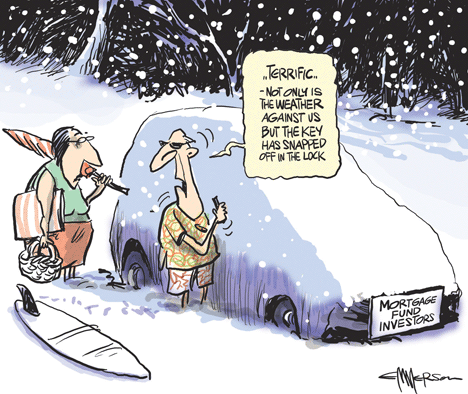
On Tuesday, the U.S. Senate rejected a measure that would have limited the “Servicer Safe Harbor” provision of the “Helping Families Save Their Homes Act,” which aims to protect servicers from lawsuits over their modifications of residential mortgage loans. The amendment to narrow the safe harbor, sponsored by Senator Bob Corker (R-TN), was defeated by a margin of 63 to 31.

The defeated amendment would have provided some mortgage bondholders, such as Bill Frey, the right to sue mortgage servicers if they lowered a borrower’s monthly payments in violation of servicers‘ contract obligations. As discussed in prior posts, the largest mortgage servicers are banks that were often responsible for originating these predatory or unsound loans in the first place, but which sold the loans into securitizations and maintain only servicing rights as to these loans. As servicers, these entities receive a fee for interfacing with borrowers and collecting payments, and they have contractual obligations to maximize returns for securities holders. Instead, servicers are being pressured (and have other financial incentives) to modify mortgages to help keep borrowers in their homes, a campaign that would cost investors billions.

But the news is not all bad for bondholders who are attempting to force servicers to bear the costs of their irresponsible lending. A number of major media outlets, including the Wall Street Journal, have now picked up this story thanks to recent lobbying efforts by Frey and others in Washington. As the Journal article shows, congressmen and the news media are beginning to understand that helping servicers at the expense of bondholders is not only inequitable and bad for future investment in the United States, but it might even run afoul of the Fifth Amendment’s Takings Clause.

Posted in costs of the crisis, Helping Families Save Homes, homeowner relief, incentives, investors, irresponsible lending, legislation, Servicer Safe Harbor, William Frey | Leave a comment

Bondholders Battle Back Over Servicer Safe Harbor

Back in early March, without much fanfare, the U.S. House of Representatives passed H.R. 1106, entitled the “Helping Families Save Their Homes Act of 2009”, which contained a “Servicer Safe Harbor” provision that would allow servicers to disregard bondholders’ contract rights when modifying mortgages. It now appears that the bill will not fly so easily through the Senate (keep tabs on the progress of this bill here at govtrack.us or here at thomas.loc.gov).

On March 25, 2009, Bill Frey, the head of hedge fund Greenwich Financial Services LLC, gave a talk in Washington to more than 30 money managers with stakes in the $6.7 trillion mortgage bond market, warning them that government efforts to assuage the housing crisis will undermine debt contracts and do more harm than good. Also presenting at the bond investor conference, which was attended by, among others, representatives from Royal Bank of Canada’s Voyageur Asset Management Inc. and Thrivent Financial for Lutherans, were David Grais, the lawyer who represents Frey in his suit against Countrywide (which may have prompted this bill), and Laurie Goodman, an analyst at Amherst Securities and UBS AG’s former fixed income research chief. According to this interesting report from Bloomberg, as a result of this meeting, a group of investors with residential mortgage-backed securities (RMBS) holdings totaling more than $100 billion hired Patton Boggs LLP, Washington’s biggest lobbying firm, to gear up for the fight in Washington over the pending legislation.
As part of this new lobbying effort, Grais and his firm, Grais & Ellsworth LLP, have issued a press release entitled “Five Reasons Why ‘Servicer Safe Harbor’ Would be Bad for America.” This release does an excellent job of explaining the perverse consequences of the bill, while capturing in straightforward terms the various reasons why mortgage bondholders oppose this legislation, despite its purported purpose of “helping families save their homes.” For one, bondholders negotiated for the valuable contract rights at issue, which impose the cost of modifications on servicers (Grais identifies these servicers as “mainly the Big Four Banks, Bank of America, Citibank, JP Morgan and Well[s] Fargo”), as a precondition to investing their money into RMBS. Bondholders secured these rights because they knew that modifications would otherwise come out of their bottom line, not from that of the servicers who had the discretion and authority to conduct loan modifications. Allowing servicers to abrogate these rights would unfairly place the financial burden of modifications on bondholders and thereby discourage future investment in the RMBS market.
A second reason is that, while servicers don’t hold many of the senior or first-lien mortgages on their books, they do hold many junior or second-lien loans. By law and/or contract, second liens are often required to be modified before first liens. Allowing servicers to modify first liens before or in lieu of second liens improves these banks’ bottom lines at the expense of their investors.
Third, the legislation offers cash incentives of $1,000 per loan modified and other incentives to the servicers, allowing the entities that made a fortune from lending and then passing off loans that borrowers couldn’t afford to further profit from going back and attempting to correct their mistakes.
When Grais runs into a bit of trouble is when he claims that the Servicer Safe Harbor “would not help homeowners.” Grais’ argument is that servicers will often increase the principal balance of loans they modify by adding the extra fees they charge borrowers who fall behind. He contrasts this with investors’ plan for modifications, which he claims will “reduce principal to give homeowners equity.” What Grais doesn’t tell us is how many mortgages will be modified if the Servicer Safe Harbor is passed versus under the investors’ plan. Ultimately, most homeowners would choose to stay in their homes, even at the expense of an increase in principal, over having to leave because they couldn’t afford their current mortgage payments. And while the investors’ plan may favor lowering principal balances, the likely consequence will be a higher monthly payment than under the banks’ modification plans.
In the end, there is little argument that the Servicer Safe Harbor will likely result in more mortgages being modified than before, something that investors, banks, politicians and homeowners would all agree is a good thing. The real fight is over who should pay for these modifications, and Grais and Frey would be wise to keep the focus on this debate. Investors believe that either the government or the banks should bear the costs, while the banks would like nothing more than to place the burden on the investors. Washington now appears likely to be the one to decide this issue, and as is often the case (unfortunately) when it comes down to politics, the answer will be in large part a result of how much money has been spent on lobbying and campaign contributions. Just look at the two politicians who introduced the “Helping Families Save Their Homes Act” in the House, Paul E. Kanjorski (D-PA) and Michael N. Castle (R-DE). Bank of America (which now owns Countrywide) was the second biggest contributor to Castle’s campaign during the 2007-2008 election cycle, making Castle one of the top 10 beneficiaries of BofA last year (behind only presidential candidates). Kanjorski was the second biggest recipient of Countrywide campaign contributions since 1989. Clearly, BofA expects (and has received) a tangible return on its investment.
Yet, there is already evidence that bondholders’ lobbying efforts are countering those of the big banks and paying significant dividends. Though the mainstream media had up to this point largely ignored the Servicer Safe Harbor issue, Gretchen Morgenson, a columnist for the New York Times, published a column last week discussing the “unintended consequences” of the Helping Families Save Their Homes Act and loan modifications in general. Morgenson notes, correctly, that while “big-time speculators and market sophisticates” make up part of the group of investors who would be harmed by this bill, the group also includes ordinary individuals who invested in mutual funds and other professionally managed accounts that acquired RMBS as part of their portfolios. Ultimately, if votes mattered more than dollars (a debatable proposition), it would be this argument, with its populist appeal, that
would carry the day in Washington.

Thank you to David Proman and Chris Corio who contributed helpful insight and research to this story – IMG.
Posted in BofA, Countrywide, Greenwich Financial Services, Helping Families Save Homes, irresponsible lending, legislation, loan modifications, lobbying, Servicer Safe Harbor, William Frey | 2 Comments

Center For Responsible Lending Publishes Report Linking Failures of WaMu and IndyMac to Poor OTS Oversight

The Center for Responsible Lending (CRL), a non-profit, non-partisan research and policy organization, has released a report that begins to shed some light on the role that lax regulation played in the mortgage meltdown of the last year and a half. The report, entitled “The Second S&L Scandal,” is subtitled, “How OTS allowed reckless and unfair lending to fleece homeowners and cripple the nation’s savings and loan industry.”

CRL has released several insightful and informative reports in the aftermath of this crisis that have helped to uncover what was really going on towards the tail end of the housing bubble and how such irresponsible lending and oversight were allowed to take place. In a prior posting, I discussed CRL’s jaw-dropping look into the pervasive culture of quantity at the expense of quality prevailing at IndyMac Bank prior to its collapse in July 2008, entitled “IndyMac: What Went Wrong.”

“The Second S&L Crisis” also includes insight into the culture of excess and irresponsibility that ran rampant at IndyMac and Washington Mutual (WaMu) during the housing bubble. But even more eye-opening is its account of the role that the Office of Thrift Supervision (OTS) played in the collapse of these two institutions. CRL’s conclusion? That, unequivocally, “OTS failed in its responsibility to ensure the safety and soundness of thrifts and to protect consumers from abusive practices” (p. 1).

Among CRL’s findings, some of the most shocking are that OTS actually obscured the seriousness of thrifts’ financial problems, going so far as to allow banks to falsify financial results to mask poor performance (p. 1, 6, 10). In IndyMac’s case, despite the fact that several prominent measures of the bank’s financial health showed significant signs of trouble as of June 30, 2007, OTS failed to place IndyMac onto the FDIC’s list of troubled institutions until June 2008, just one month before the bank’s July failure! The report also cites a probe by the Treasury Department’s Inspector General that found that, “just two months before IndyMac’s collapse, [an] OTS official gave the thrift permission to falsify its financial statements, a move that allowed it to avoid increased regulatory oversight” (p. 6).

In WaMu’s case, the “reckless disregard” of OTS was even more egregious. WaMu was not placed on the federal government’s list of troubled banks until one week before the bank’s failure (p. 10)! This was despite the FDIC’s efforts in August 2008 to downgrade WaMu’s supervisory rating–a preliminary step clearing the way for WaMu to be placed on the list of problem banks–to which OTS responded that WaMu was stable and that OTS was working to correct the problem (p. 10).

CRL’s findings have since been largely corroborated by an Audit Report regarding IndyMac from the Office of the Inspector General at the Department of Treasury, released February 26, 2009, that was generally critical of OTS oversight of the thrift. The Report found that OTS did not take aggressive action to curb irresponsible lending practices despite many warning signs, and it alludes to the curious fact that IndyMac was not placed on the FDIC problem list until June 2008. In fact, the Report states, OTS should have taken enforcement action against IndyMac as early as 2005!

The Inspector General’s Audit Report generally recommends only that OTS senior leadership “reflect carefully on the supervision that was exercised over IndyMac and ensure that the correct lessons are taken away from this failure” (p. 34). CRL’s Report goes much further, recommending that OTS be eliminated entirely and its role subsumed under the Office of the Comptroller of the Currency (OCC).

CRL also recommends that “[m]arket incentives be aligned to ensure that no party can shirk responsibility for making responsible lending and investment decisions” (p. 23). The Report suggests that this be done by creating assignee liability–that is, by allowing borrowers to go after the trust holding their mortgages in a pool for the benefit of bondholders–when loan transactions are alleged to be illegal, abusive or harmful. While I completely agree that the re-alignment of incentives would go a long way toward preventing irresponsible lending by those with no skin in the game (see my prior post on market incentives), I don’t necessarily agree that assignee liability makes the most sense.

In fact, it is the loan originators and the sellers and sponsors of residential mortgage backed securities (RMBS) who are in the best position to know the facts and circumstances underlying any particular mortgage and the best position to prevent irresponsible lending (see my prior post on misguided protesters directing their anger at Bill Frey and Greenwich Financial’s lawsuit against Countrywide). However, it was these very parties who had nothing to lose by churning out as many loans as possible, because they could turn around and sell them to voracious investors, generating huge fees and passing off most of the risk of default. RMBS investors, and the trusts that represent them, already have every incentive to police these loans for unsound lending practices, because the quality of the loans directly impacts the loans’ default rate and thus the investors’ return on investment. Why they didn’t do so during the housing bubble is an open question, but lack of transparency, investors’ own greed and outright misrepresentations made by originators, sellers and sponsors certainly contributed.

When I raised this issue with Michael Hudson, author of The Second S&L Scandal, he made a number of fair points. First, he noted that, “[a] big part of this [is] that many thinly capitalized brokers and lenders can go out of business or file [for] bankruptcy (and reemerge under some other guise) when there’s an allegation of bad origination practices.” Therefore, it made more sense to go after the big players who purchased the loans and would stick around to face the music. Second, he pointed out that determining whether loans were being done right was not difficult, but that, “big players who were aggregating and bundling loans purposefully turned a blind eye to evidence that fraud and predatory lending was commonplace” (something I’ve seen repeatedly in my work in the subprime industry).

While these are great points, the solution as I see it is not to hold the ultimate trust and bondholders responsible, both because they play no direct role in making these fraudulent or abusive loans, and because they are not in the best position to detect or curb this practice. Instead, the “seller and sponsor” of a securitization–the investment bank that created the securitization, bought the loans, pooled them into a trust, and then marketed and sold them to investors–is the entity at the heart of the RMBS system and in the best position to fix it. These are not fly-by-night brokerages, but large Wall Street players with the most to gain (and lose
) from securitizations and the clout to change the way that loans are made. If securitizations going forward are structured such that the seller and sponsor bears the first loss or can be readily held liable if the loans in the pool are determined to be defective, I think we’ll see abusive lending and delinquency rates decrease across the board.

Just ask Bill Frey, whose firm, Greenwich Financial Services, helped to structure one of the first mortgage backed securitizations in Russia in 2006 (see press release here). He told me that he structured these deals so that the lender/servicer took the first loss, the investment bank took the second loss, and only then did the bondholders take any loss on their investment. It just so happens that with this moral hazard problem removed, these deals are performing far better than comparable deals in the United States. All of which reinforces the notion, echoed by Hudson in the CRL Report, that by re-aligning incentives, securitizations can still work as an effective vehicle for spreading risk without incentivizing irresponsible lending.
Posted in causes of the crisis, Center for Responsible Lending, Greenwich Financial Services, incentives, IndyMac, irresponsible lending, OTS, oversight, Russian MBS, sellers and sponsors, WaMu, William Frey | 1 Comment

Geithner Plan’s Use of Wall Street Firms to Value “Toxic” Securities No Panacea

Several commentators have recently praised Treasury Secretary Tim Geithner’s plan to use Wall Street firms to help value “toxic” assets, such as mortgage-backed securities (MBS) and collateralized debt obligations (CDOs), because it draws on these firms’ supposed expertise in valuing securities. For example, Richard Posner, on the Becker-Posner Blog, had this to say about the plan:

Although my guess is that the political factor is the major driver of Gaithner’s [sic] complex plan, the plan does have other advantages, so that on balance, despite
its higher transaction costs and likely longer delay in implementation, it may
conceivably be the superior approach quite apart from the political imperative.
It will simplify the banks’ balance sheets by removing assets of uncertain value
and replacing them with cash, and it will draw on private-sector expertise in
valuing assets and in negotiating transactions. The government could of course
hire a Wall Street firm to advise it on the purchase of assets from banks, but
both the carrot of profit and the stick of competition are likely to be stronger
motivators to efficient transacting, and this argues for making private firms
buyers rather than just advisers. [Note that this entry, posted by Posner on or about March 29, 2009, appears to have since been removed]

As an initial matter, the reason that these assets are being referred to as “toxic” is not because they “infect” other assets on banks’ balance sheets per se, but because they are so difficult to value that they cause uncertainty and financial paralysis. Yet, as I commented on the Posner post, the solution is not as simple as simply bringing in Wall Street banks or hedge funds to help value the securities, for several reasons.

First, it is not at all clear that these Wall Street players know how to properly conduct due diligence and re-underwrite the underlying mortgage loans to determine how many are likely to pay out and how many are likely to default. This is an extremely time-consuming and non-scientific process, and one that these same firms were manipulating during the housing boom (often under the cover of third-party due diligence firms) to make the securities appear less risky to investors. Who’s to say they’ve now learned how to properly value MBS and will do so in an entirely unbiased manner, especially when they would benefit as buyers from undervaluing these assets?

Second, whether or not the underlying mortgage loans will perform is highly contingent on the current legal and political battle over loan modifications. The most efficient solution to the valuation problem from a bondholder perspective would be to quickly foreclose on all defaulted loans, liquidate these assets, and move forward with only performing mortgages remaining in the securitization structure. However, there is immense political pressure in the current environment to help delinquent borrowers stay in their homes by performing loan modifications. As I’ve discussed in previous posts, Countrywide has settled lawsuits by dozens of state Attorneys General by agreeing to modify 400,000 loans by, for example, lowering monthly payments or interest rates. But because many of these loans have been securitized, Countrywide no longer owns them and acts only as servicer, and any reduction in monthly payments would be borne by the ultimate bondholders. Some bondholders have challenged the Countrywide settlement, alleging that it constitutes improper loss-shifting and violates the securitization agreements. Now, the U.S. House of Representatives has passed, and the Senate is considering, a Servicer Safe Harbor, which proposes to allow servicers such as Countrywide to ignore such contractual obligations (and even gives them a $1000 cash incentive for each loan they modify!). The outcome of this pending litigation and legislation will have a considerable impact on the value of these “toxic” assets, and presents additional uncertainty preventing their accurate valuation, by Wall Street or anyone else.

Posted in Countrywide, due diligence firms, hedge funds, legislation, loan modifications, re-underwriting, Richard Posner, Servicer Safe Harbor, Timothy Geithner, toxic assets, valuation, Wall St. | Leave a comment

New Century Debtors’ Complaints Against KPMG Now Available

The two complaints filed April 1 against KPMG, one against the U.S. arm of the Big Four accounting firm in federal court in Los Angeles and the other in federal court in New York against its parent, KPMG International, are embedded and linked below. Assuming these allegations are true, ask yourself, if you were a juror on either case, whether you would be convinced that KPMG’s irresponsible accounting could have been a direct and foreseeable cause of the collapse of New Century Financial. It strikes me that plaintiffs will not have an easy time justifying their request for $1 billion in damages.

KPMG Intl New York Complainthttp://d.scribd.com/ScribdViewer.swf?document_id=13927228&access_key=key-763ppwcpfyop1ovaqkd&page=1&version=1&viewMode=

KPMG California Complainthttp://d.scribd.com/ScribdViewer.swf?document_id=13927229&access_key=key-2elvfq1kb1g8tw5z00ec&page=1&version=1&viewMode=

Posted in accounting, bankruptcy, causes of the crisis, Complaints, damages, KPMG, lawsuits, loss causation, negligence and recklessness, New Century, subprime | Leave a comment

KPMG Sued for $1 Billion Over New Century Meltdown

Two separate lawsuits were filed yesterday against Netherlands-based Big Four accounting giant, KPMG International, and its U.S. subsidiary, KPMG LLP, alleging that KPMG conducted “reckless and grossly negligent audits” that contributed to the collapse of top subprime lender New Century Financial in April 2007. If successful, these actions would mark the first time a Big Four accounting firm is held legally liable for the actions of its U.S. subsidiary.

According to the New York Times’ Deal Book Blog, the lawsuits were filed on behalf of a liquidating trust formed by New Century Debtors, and alleges that “KPMG failed in its public watchdog duty” and helped cover up “catastrophic” problems at New Century. New Century was the first major subprime lender to file for bankruptcy as a result of the housing downturn nearly two years ago, and is largely credited with triggering a wave of additional bankruptcies that turned the subprime mortgage crisis into a full-scale global credit crisis. At its peak, New Century was the second-largest subprime lender in the United States.

The two lawsuits, one filed in federal court in New York and the other in federal court in Los Angeles, target the parent company and the U.S. arm of KPMG separately. However, their allegations largely overlap. Though he hadn’t seen the complaints, KPMG spokesman Dan Ginsburg issued a statement saying:

KPMG acted in accordance with professional standards in New Century, and we will vigorously defend our audit work. Any implication that the collapse of New Century was related to accounting issues largely ignores the reality of the global credit crisis. This was a business failure, not an accounting issue.

However, the lawsuits cite emails that allegedly show that specialists within KPMG tried to point out errors in New Century’s financial statements but, as we have seen so often in the shakeout from this crisis, higher-ups in the company silenced these objections in an attempt to protect business relationships. And while it is almost certainly true that, had KPMG spoken out about these errors, New Century would have found itself a new auditor that would have gone along with its shenanigans, that loss of business would have been orders of magnitude smaller than the liability KPMG faces in these actions. If KPMG is held liable, it will mean that major financial players will no longer be able to hide behind “group-think” and an “everyone else is doing it” justification to blindly pursue financial gain, whatever the cost to others. And ultimately, realigning incentives so that actors do the “right” thing is one of the most important functions of the law.

Posted in accounting, auditing, bankruptcy, causes of the crisis, incentives, KPMG, lawsuits, loss causation, negligence and recklessness, New Century | Leave a comment

Countrywide Complaint Against A.I.G. Subsidiary United Guaranty Now Available

Earlier this week, I posted the complaint filed by A.I.G. subsidiary United Guaranty Mortgage Indemnity Co. (UG) in federal court in Los Angeles. The Subprime Shakeout has now obtained the complaint that started this battle of mortgage industry titans, filed by Countrywide on March 18, 2009 in Los Angeles County Superior Court.

The complaint, also embedded below, alleges that UG refused to pay claims by Countrywide on losses covered under the terms of its insurance policies. Countrywide seeks declaratory relief, compensatory damages based on breach of contract and punitive damages breach of the implied covenant of good faith and fair dealing.

A few observations about this dispute:

  • Removal: The first major battle in this case will likely be over the removability ofCountrywide’s state court action. As UG has brought a related action in federal court in Los Angeles (based on diversity jurisdiction), it will likely remove Countrywide’s action to federal court and attempt to consolidate the actions. Countrywide, apparently anticipating this move, has named Countrywide Servicing LP as a plaintiff and alleged that the entity is a North Carolina citizen, making it non-diverse from UG (also a North Carolina entity). While Countrywide Servicing is organized under the laws of Texas and has its principal place of business there, Countrywide argues that Countrywide Servicing is a citizen of North Carolina because the General Partner and Limited Partner of Countrywide Servicing (neither of which, incidentally, are organized under the laws of North Carolina) “are citizens of North Carolina, as their sole owner/member is Bank of America,” which has its main office in North Carolina. This is one of the most convoluted attempts to destroy complete diversity that I’ve seen, and it seems unlikely that Countrywide will succeed in having the case remanded to state court.
  • Loss Causation: Countrywide, like UG, confronts the loss causation issue head-on, arguing that it’s been conducting its lending operations in the same manner that it has for years, and that UG is only complaining now that the housing market has collapsed and the country is in a “deep economic recession” (see pages 24-25). Though Countrywide maintains that “[t]he increase of defaults is not limited to loans originated by Countrywide, but is a phenomenon occurring nationwide and has impacted all mortgage lenders” (page 25(emphasis added)), it is unclear whether the absolute default rates on the pools of Countrywide loans at issue here are greater than comparable pools. Countrywide maintains that they are (at pages 26-27), but such numbers can be manipulated depending on the pools chosen as “comparable.” UG would be wise to further develop its allegations and supporting evidence in this regard if it hopes to refute Countrywide’s contention that the market, not Countrywide, caused UG’s losses.
  • Sophistication: Another interesting dichotomy set up by these two complaints is the sophistication of UG in insuring subprime mortgage loans. While UG argued in its complaint that “[p]rior to 2006, United Guaranty had very limited experience insuring subprime mortgage loans,” (see UG Complaint, page 14) Countrywide argues that UG, “is a sophisticated market actor in this area” (see Countrywide Complaint, page 17). Countrywide goes to great lengths to show that UG understood the risks it was undertaking, quoting such diverse sources as the Mortgage Insurance Companies of America (page 18), an article by Robert Stowe in which a UG executive is quoted (page 19), and an AIG Mortgage Industry Presentation (page 20). Ultimately, however, this dispute will boil down to whether Countrywide followed its stated guidelines or not. If it did not, it will be difficult to argue that UG assumed the risk.
  • AIG’s Financial Condition: As support for its claims of bad faith and unjustified denial of coverage under the policies, Countrywide includes allegations about AIG’s and UG’s “deteriorating financial condition” (page 29) and contends that UG is unlikely to receive any financial support from its parent, AIG. Countrywide thus argues that it, “has justifiable cause to believe that United Guaranty’s recent decision to stop the payment of otherwise covered claims may be related to its financial condition and the financial condition of AIG and its affiliates, rather than to the merits of whether particular claims should be paid” (page 31). Countrywide further alleges that the only justification provided thus far by UG for its refusal to pay coverage is that “it has already paid too much” (page 28). While this line of argument may provide effective coloring or “atmospherics” underlying the suit for a judge or jury, UG has likely provided sufficient justification in its complaint for its refusal, in the form of its allegations regarding Countrywide’s deficient underwriting, to overcome Countrywide’s bad faith argument. However, the specter of bad faith must be cause for some concern at UG, especially if the claim mak
    es it past the summary judgment stage. Given UG’s tenuous financial position and its unorthodox approach of wholesale refusal to pay claims on any loans contained in the subject securitizations, regardless of individual loan characteristics, it is conceivable that a judge or jury could conclude that UG unreasonably denied coverage for the purpose of using the money elsewhere. And a punitive damages award against one of its subsidiaries is just about the last thing AIG needs in this political and financial climate.

Countrywide v. UG Complaint

http://d.scribd.com/ScribdViewer.swf?document_id=13618313&access_key=key-1bics03k17wsz6tt5itr&page=1&version=1&viewMode=

Posted in AIG, bad faith, causes of the crisis, Complaints, Countrywide, lawsuits, lenders, lending guidelines, loss causation, mortgage insurers, removability, sophistication, subprime, underwriting practices | Leave a comment

A.I.G. (United Guaranty) v. Countrywide Complaint Now Available

The complaint filed in federal court in Los Angeles by United Guaranty Mortgage Indemnity Co., the mortgage insurer subsidiary of A.I.G., against Countrywide Financial Corp., Countrywide Home Loans, Inc. and the Bank of New York Trust Company is posted below. As discussed previously, United Guaranty (UG) seeks rescission of mortgage insurance coverage and $30 million in damages from Countrywide as a result of its alleged fraudulent acts, misrepresentation, and negligence in inducing UG to insure over $1 billion in subprime mortgage loans.

Having now had a chance to take a closer look at the Complaint, I note several items of interest regarding the approach taken by United Guaranty (UG) attorneys Quinn Emanuel:

  • At page 3, UG alleges that Countrywide’s own loan files often note that “the sole justification for granting an underwriting exception was to increase its market share by matching a competitor’s offer.” If true, this is compelling evidence that Countrywide (and likely many other lenders) completely and explicitly abandoned underwriting standards in their efforts to pump out greater and greater volumes of subprime residential mortgage loans.
  • As expected, UG attempts to confront the loss causation issue (also discussed previously here) head-on, by arguing that its losses were caused, not by the economic downturn itself, but by Countrywide’s underwriting failures. Interestingly, however, UG attempts to depict Countrywide’s failures as a major cause of the larger economic downturn, arguing that:

“it has become clear that the prolifieration of high risk mortgages combined
with inadequate and fraudulent underwriting processes is largely responsible for
the historically high rate of default in the mortgage industry…Countrywide’s
combination of high risk loan products and fraudulent or willfully blind
underwriting created a perfect storm that has lead to massive defaults in the
Mortgage Loans…” (pages 3-4)

  • UG also identifies a practice allegedly pursued by Countrywide of “keep the best and sell the rest,” (pages 4, 28) meaning that Countrywide would keep the good loans on its books, and securitize or sell the worst loans to investors. I have heard that this policy was actually driven by market demand for riskier (and thus higher return-generating) bonds, but I’d be interested if anyone has any insight into whether and why this may have been done.
  • UG recounts, in detail, the various lawsuits against Countrywide filed by the Attorneys General of eleven states. UG notes that the complaints contain numerous allegations of fraud or reckless lending similar to its own findings, and that Countrywide agreed to settle the suits for an estimated cost of $8.6 billion in loan modifications within four months of the filing of the first suit (pages 5, 23-27). Yet, while UG notes that Bank of America acknowledged when it acquired Countrywide that “[t]he cost of restructuring these loans is within the range of losses we estimated when we acquired Countrywide” (page 27), the complaint make no mention of the fact that Countrywide will not actually bear the costs of these modifications because it no longer owns most of the loans. I can understand why UG is attempting to frame the settlement as an acknowledgment of wrongdoing, but it would seem even more powerful to be able to argue that Countrywide (and BofA) has thus far largely escaped the consequences of its irresponsible lending.

UG v Countrywide Complainthttp://d.scribd.com/ScribdViewer.swf?document_id=13589125&access_key=key-21c1cwvo9gvy7ilzxah8&page=1&version=1&viewMode=

Posted in AIG, allocation of loss, BofA, causes of the crisis, Complaints, Countrywide, lawsuits, litigation, loan modifications, loss causation, misrespresentation, mortgage fraud, United Guaranty | Leave a comment

A.I.G. and Countrywide Go Head-to-Head Over Mortgage Insurance Coverage

The battle of the titans has begun. As reported by Reuters on Friday, both A.I.G. and Countrywide have now sued one another over who will bear the losses on a $1 billion pool of subprime mortgage loans.

Countrywide fired the opening salvo on Wednesday when it sued A.I.G.’s United Guaranty Mortgage Indemnity Co. in Los Angeles County Court, alleging that the insurer was refusing to honor its mortgage insurance obligations. One day later, United Guaranty responded by suing Countrywide in federal court in Los Angeles, alleging that Countrywide had misrepresented the risks tied to the pool of mortgage loans and had failed to follow its own underwriting guidelines.
Based on the arguments asserted by both sides in their complaints, this clash of mortgage giants features two familiar but wildly disparate perspectives on the causes of this crisis. On one hand, Countrywide argues that United Guaranty profited for years from the premiums it received to insure loans against borrower default, but now that it is “fac[ing] the reality of steep financial losses because of a significant economic downturn,” United Guaranty is trying to escape its obligations.

On the other hand, United Guaranty argues that Countrywide took advantage of its long-standing relationship with the insurer to induce United Guaranty to insure loans that never should have been approved. According to another article in Bloomberg, United Guaranty’s review of loan files from 11 separate policies for asset-backed securities revealed that most either violated Countrywide’s own underwriting standards or had material defects such as misrepresented credit scores or fake social security numbers.

United Guaranty will likely have a mountain of salacious evidence on its side to demonstrate Countrywide’s improper and irresponsible lending, as other lawsuits against the former lending giant have revealed a shocking abandonment of underwriting standards and practices. Yet, United Guaranty will have several hurdles to overcome. First, according to its Complaint, United Guaranty has already paid out over $30 million in insurance claims on these loans. This is sure to raise arguments of waiver or estoppel by Countrywide and questions of whether the insurer should have known about the quality of loans when it placed insurance coverage or, at the very least, when it paid claims. Second, United Guaranty will have to counter Countrywide’s argument that these losses were caused by the broader economic downturn, and show that they were caused, in fact, by Countrywide’s abusive and irresponsible lending practices. United Guaranty might be able to do this by demonstrating that this pool of mortgage loans is significantly worse than comparable pools and/or by showing that Countrywide’s underwriting deficiencies directly caused the loans to fail. The latter approach will likely prove much tougher than the former, as we have already seen litigants struggle to make out the loss causation claim in prior mortgage crisis litigation.
Regardless, this heavyweight legal matchup will be closely watched by the industry and is certain to have a significant impact on future lawsuits stemming from the broader financial crisis.
Posted in AIG, allocation of loss, causes of the crisis, Countrywide, lawsuits, lenders, litigation, loss causation, misrespresentation, mortgage insurers, underwriting practices, United Guaranty | 1 Comment

Senate to Consider Bill That Threatens to Obliterate Mortgage Bondholders’ Contract Rights

On March 5, 2009, the U.S. House of Representatives passed H.R. 1106, also known as the “Helping Families Save Their Homes Act of 2009,” which threatens to override the contract rights of bondholders who invested in mortgage-backed securities (MBS). A version of the bill has been referred to the Senate Committee on Banking, Housing and Urban Affairs, but the Senate has not yet voted on the legislation. You can follow the progress of this bill here at govtrack.us or here at thomas.loc.gov.

In its current form, H.R. 1106 contains several provisions that would undermine investors’ contract rights and could result in a significant shifting of economic losses to bondholders. First, the bill will allow judicial modification of primary residential mortgages in borrowers’ bankruptcy proceedings (also known as “bankruptcy cramdowns”). This means that judges can now forgive principal on the debtor’s primary residential mortgage, just as they already could for other types of debt. This change in the bankruptcy codes, part of President Obama’s economic plan, has been anticipated for some time, especially since banks began relaxing their opposition to this idea (see prior posting regarding Citigroup here).

However, the troubling aspect of H.R. 1106 for investors is Section 124, which renders unenforceable, as against public policy, any provisions of investment contracts between servicers and securitization vehicles that require excess bankruptcy losses over a certain dollar amount to be borne by all classes of certificates on a pro rata basis. What that means is that instead of having bankruptcy losses hit every bond in the capital structure proportionately, the losses from bankruptcy cramdowns will now “trickle up” from the most junior bonds before hitting senior bonds (the traditional way losses are treated).
Yet, such pro-rata loss provisions in securitization contracts were put in place specifically to attract investors for the junior classes of securities and assuage their concerns that they would be disproportionately exposed to excess bankruptcy losses. Currently, many of the senior classes of bonds in these securitizations are held by major lending institutions who fear that downgrades will put significant pressure on the amount of capital they’re required to hold by law. The practical impact of Section 124 is thus to shift the the loss burden from banks to bondholders. I’ll discuss the constitutionality concerns raised by such a shift in a later posting, but query whether, from a purely equitable standpoint, the risk that borrowers would not be able to make their mortgage payments should be born by banks that often underwrote and issued these loans, or by the outside investors who specifically contracted against bearing that risk.
The second provision raising equitable concerns is the so-called “Servicer Safe Harbor.” This provision will have a direct impact on who will bear the losses for loan modifications, another important issue for the financial well-being of banks, and one that has been discussed at length in prior postings on this blog. Again, many contracts governing securitizations contained provisions mandating that servicers bear the costs of any loans they modify, such as by lowering a borrower’s interest rate, extending the duration of the loan, or reducing the borrower’s principal balance. This is the precise issue being litigated in a suit by Greenwich Financial Services against Countrywide (see prior postings here).
The Servicer Safe Harbor provision of H.R. 1106 threatens to cause a sea change in the loan modification landscape. Pursuant to this provision, servicers will not be obligated to repurchase loans or make payments to the securitization vehicle because of loan modifications or other loss mitigation plans, so long as the loans subject to modification are in default or default is reasonable foreseeable (which is the case for most loans eligible for modification). As if this shift in liability wasn’t dramatic enough, the bill also provides cash incentives ($1000 per loan) for servicers to modify loans, in an attempt to help defray origination costs. Keep in mind that these will apply more often than not to the same servicers who originated the loans and were often grossly negligent in underwriting the loans to determine if the borrower actually had the ability to repay. Not only would this bill let such servicers off the hook for their irresponsible lending practices (see, e.g., prior postings here and here on Countrywide passing off the costs of its settlement with Attorneys General), but servicers will now get handouts from the Government for correcting their mistakes! With the current political climate so supportive of “Helping Families Save Their Homes” and easing the rates of foreclosure, it seems that the goal of allocating losses fairly to the parties who contributed most to this mess has been utterly forgotten.
Check back soon for an analysis of the potential constitutional challenges to H.R. 1106 if, as expected, the bill is passed by the Senate in the coming weeks…
Posted in allocation of loss, bankruptcy, bankruptcy cramdown, Countrywide, Greenwich Financial Services, Helping Families Save Homes, legislation, litigation, loan modifications, Servicer Safe Harbor | 1 Comment